
Stop Trying to Fill the Boxes: A Better Way to Think About Programming
You are not planning for the boxes. You are planning for children, learning, and intentional teaching. The boxes come after. Move beyond a box-filling exercise and into intentional documentation.

If Part 1, What to Include in Each Programming Box (and Why There’s No “Wrong” Box), helped you understand what could go in each programming box, this is the part that matters most.
Because this is where many educators get stuck.
They start planning by looking at the boxes and thinking:
- “What should I put here today?”
- “I haven’t filled this one yet…”
- “I need something for outdoor / creative / cognitive…”
- “What experiences should go in the environment box?"
And before long, programming becomes about filling space instead of supporting learning.
The Shift That Changes Everything
You are not planning for the boxes.
You are planning for children, learning, and intentional teaching.
The boxes come after.
The order should always be:
-
What are children showing me?
-
What learning do I want to support or extend?
-
What experience or opportunity will I offer?
-
Then — where does this best fit? Now you know your purpose, you can match the learning intention to the box that best represents your goals (if pre-planning) or the visible learning (if recording a child's spontaneous learning).
When you work this way:
- Your program becomes clearer
- Your documentation becomes stronger
- Your confidence increases
- And your practice aligns naturally with the EYLF / MTOP v2.0 and the NQS
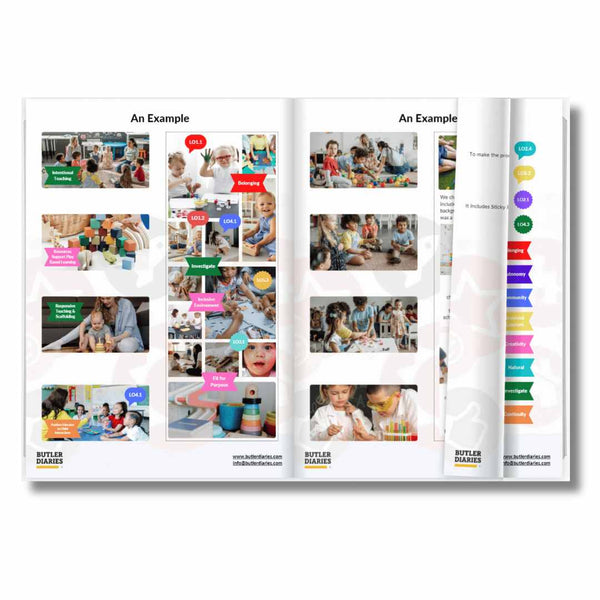
This is why the layout of the Weekly Programming and Reflection Diary was updated. It prompts intentional decision-making within the learning frameworks, moving away from filling-in-the-box exercises.

You Do NOT Need to Fill Every Box
Let’s say this clearly, because this is where unnecessary stress builds:
- You do not need something in every box.
- You do not need something in every box every day.
- You do not need to “balance” your page visually.
If you try to fill every box, you are no longer planning intentionally.
You are just spreading experiences thinly across categories.
This is not to say some programs won't be completely full because some will. It just means that your goal should not be to try to fill every box. Your goal should be to create a holistic program centred around children's goals and however that looks is okay!

What assessors are actually looking for:
- Depth of learning
- Clear intentional teaching
- Evidence of the cycle of planning
- Professional judgement
Not:
- Evenly filled boxes
- Aesthetic layouts
- Perfect distribution of experiences
While your program can be beautiful and unique (as we've seen from Educator examples!), it doesn't have to be. The value comes in quality documentation, not quantity or appearance.
There Is No “Wrong Box”
This is the second biggest shift.
There is no single correct place for an experience.
There is only:
What was your intention?
Example:
A child-led block build could be:
Cognitive / Language → if the focus is problem-solving
Group Learning → if you intentionally extended it
Creative → if the focus was design and expression
Wellbeing → if it supported collaboration and confidence
Same experience. Different lens.
This one experience could be recorded in a different box every week and the only change being the child's learning and your intentional teaching.
If you can explain:
- what the children were doing
- what learning was happening
- what you were supporting
Then your placement is valid.

Boxes Do Not Define the Learning
This is where many educators unintentionally limit their programs.
They start thinking:
“This is a cognitive activity”
“This is a creative activity”
But learning doesn’t happen in categories.
Learning is:
- messy
- interconnected
- happening all at once
A single experience can support:
- language
- social skills
- problem-solving
- wellbeing
- identity
At the same time.
Another reason why there is no right or wrong box.
Your documentation should reflect that understanding — not reduce it.
Intentional Teaching Is the Anchor
If you’re ever unsure where something belongs, come back to this:
What was my intentional teaching focus?
That is what determines placement.
Not:
- the materials
- the location
- the type of activity
But the learning you were supporting.

This is what strong practice looks like:
“I placed this under wellbeing because my intention was supporting emotional regulation through collaborative play.”
That is exactly the kind of thinking that aligns with:
• QA1.1.2 – Child-centred
• QA1.2.1 – Intentional teaching
• QA1.2.2 – Critical reflection
You do not need to record this explanation every time. You can reflect on your program and intentional teaching in the reflection box as appropriate to show how you are building an intentional program aligned with frameworks and children's interests.
The Risk of “Box-Filling” Programming
When programming becomes about filling boxes:
- Experiences become rushed or unnecessary
- Intentional teaching becomes unclear
- Documentation becomes weaker
- Educators lose confidence and feel burnt out
And most importantly:
The focus shifts away from children’s learning.
What to Do Instead
Before you even look at your programming spread, reflect in your reflection spread:
- What did I observe?
- What learning is emerging?
- What needs to be extended or supported?
- What is my role as the educator here?
Then plan.
Then place it.

A More Accurate Measure of Quality
Instead of asking:
“Did I fill every box?”
Ask:
- Is my intention clear?
- Can I explain the learning?
- Can I show how this links to the framework?
- Can I show how this will be extended?
That is what demonstrates quality.
Where This Shows in Your Documentation
When you shift your thinking:
- Your Weekly Programming and Reflection Diary shows clearer intent
- Your reflections become stronger and more analytical
- Your extensions become more meaningful
- Your Children’s Voices become easier to capture
You stop documenting more…
and start documenting better.
Final Reframe
The boxes are not the program.
They are just the place where you record it.

More Examples: Same Experience, Different Intentional Teaching
Here are more examples showing how the same experience can fit in multiple boxes depending on the learning intention.
Example 1: Block Play
A child-led block build could be:
Cognitive / Language → if the focus is problem-solving, spatial awareness, or collaboration
Group Learning / Intentional Teaching → if you intentionally joined and extended the build with questions or challenges
Creative → if the focus is design, imagination, or constructing representations
Wellbeing / Mindfulness → if the focus is teamwork, persistence, or confidence
Example 2: Reading a Story
Reading The Very Hungry Caterpillar could be:
Group Learning / Intentional Teaching → if you planned it to explore healthy eating
Cognitive / Language → if the focus is sequencing, vocabulary, or comprehension
Wellbeing / Mindfulness → if the discussion focuses on healthy bodies and self-care
Environment / Cultural → if it links to nature, life cycles, or sustainability
Example 3: Sandpit Play
Children playing in the sandpit could be:
Children’s Spontaneous Learning → if it is child-initiated exploration
Cognitive / Language → if children are measuring, comparing, or problem-solving
Creative → if they are building structures or imaginative worlds
Outdoor Experiences → if your focus is physical play or connection to the environment
Example 4: Mealtime
A shared meal could be:
Wellbeing / Mindfulness → if the focus is healthy eating or self-help skills
Cognitive / Language → if children are engaging in rich conversation
Group Learning → if you intentionally introduce discussions about nutrition
Children’s Spontaneous Learning → if peer conversations lead the learning
Example 5: Drawing or Painting
A painting experience could be:
Creative → if the focus is expression, colour, and design
Cognitive / Language → if children are storytelling through their artwork
Wellbeing / Mindfulness → if it supports emotional expression or regulation
Group Learning → if you are intentionally teaching a technique or concept
Example 6: Outdoor Climbing
Children climbing could be:
Outdoor Experiences → if the focus is physical development and risk-taking
Wellbeing / Mindfulness → if the focus is confidence and resilience
Cognitive → if children are problem-solving how to navigate the equipment
Group Learning → if you intentionally scaffold safe risk-taking
You are not categorising experiences. You are documenting learning through intention. Choose the box that best reflects that.
Want More Support Putting This Into Practice?
If this shift feels like a big one, you’re not alone — it’s one of the most common mindset changes educators make.
Our Weekly Programming and Reflection Diary Guide walks you through:
- how to plan in line with frameworks
- how to explain your decisions during Assessment and Rating
- how to strengthen intentional teaching without increasing workload
You can also explore the Cycle of Planning Professional Development Training for deeper examples of how this looks in real practice.
Related Articles
-
What to Include in Each Programming Box (and Why There’s No “Wrong” Box)
-
Understanding the New Weekly Programming Reflection Diary Layout
-
How to Do Weekly Programming & Reflection Using the Cycle of Planning (EYLF, MTOP v2.0)
-
How to Enhance Documentation With Codes
-
Support Directories: Finding the Support You Need on Our Website