
How to Do Weekly Programming and Reflection Using the Cycle of Planning
This post breaks down a simple weekly routine based on the Cycle of Planning, and shows how to document it in a way that’s realistic, consistent, and evidence-friendly. It is a practical step-by-step guide for overwhelmed educators who want clarity, consistency, and evidence without over-documenting.

A practical step-by-step guide for overwhelmed educators who want clarity, consistency, and evidence without over-documenting.
If you’ve ever stared at a programming page thinking:
-
What am I meant to write here?
-
Am I documenting enough?
-
Is this even the “right” kind of reflection?
-
How do I show evidence of learning without writing a novel?
- Is this meant to feel like so much work?
…you’re not alone.
Programming in Early Childhood Education and Care isn’t just planning experiences. It’s about making learning visible, showing intentionality, and being able to explain why decisions were made — in a way that aligns with the Early Years Learning Framework (EYLF v2.0) and My Time, Our Place (MTOP v2.0) Framework, which positions curriculum decision-making as a continuous cycle of planning, assessment, and critical reflection.
This post breaks down a simple weekly routine based on the Cycle of Planning, and shows how to document it in a way that’s realistic, consistent, and evidence-friendly.

What is the Cycle of Planning (in plain language)?
The EYLF planning cycle describes the process educators follow in planning, documenting, responding to and supporting children’s learning — and documentation occurs at every stage.
In practical terms, the Cycle of Planning is:
-
Observe / collect information
-
Analyse / assess learning (what does it mean?)
-
Plan learning opportunities
-
Implement experiences and intentional teaching
-
Evaluate / reflect
-
Adjust and plan next steps
This sounds straightforward — but most educator overwhelm comes from not having a clear system for applying it week-to-week. For a more detailed refresher on the Cycle of Planning, read MTOP and EYLF Planning Cycle Explained: V2.0.
The most common programming mistake: trying to document everything
One of the biggest traps in Early Childhood Education and Care is believing:
“If I don’t write it down, it didn’t happen.”

That leads to:
-
over-documenting
-
rushed or meaningless reflections
-
programming that becomes “paperwork for paperwork”
-
educator burnout
High quality isn’t measured by volume — it’s measured by clarity:
-
Can you explain your decisions?
-
Can you show learning progress?
-
Can you demonstrate evaluation and responsive planning?
You don’t need more writing. You don't need an experience or reflection in every box in your Weekly Programming and Reflection Diary every week.
You need a structure that makes the planning cycle sustainable.
If you're using the Butler Method and feeling like there is too much work... you may have fallen into this trap. The Weekly Programming and Reflection Diary Guide is designed to help you understand the simplicity of the Butler Method to help you avoid over-documenting. View the free introduction tutorial, The Butler Method Tutorial.

A Weekly Programming Routine that Aligns with the EYLF Cycle of Planning
Here’s the best part: you don’t need to “do the whole planning cycle” in one sitting.
Instead, you can spread it across one or two weeks and document as you go — in a way that builds evidence naturally.
Educators have shared they can complete their cycle of planning in their Weekly Programming and Reflection Diary in as little as 10 minutes per day.
Step 1 (End of previous week / Start of week): Program with purpose (Plan)
At the end of the previous week or beginning of the current week, anchor your planning around:
-
children’s interests & emerging ideas from your previous week's program
-
intentional teaching focus
-
what’s actually realistic for routines/ratios/your context
- the critical reflections in your reflection spread
What to document:
-
environment set-ups and provocations
-
planned learning opportunities (group/small group/spontaneous)
-
intentional teaching strategies (modelling, scaffolding, questioning)
-
clear learning goals / developmental focus
You do not need to pre-plan every box in your Diary. Some weeks you may pre-plan 2 experiences, other 10, it all depends on what your previous cycle (program and reflection spread, i.e., the Butler Method) is telling you.
We need to rememeber, we pre-plan to show intentional teaching around children's interests and goals, we leave room for adaptions and spontaneous choices as they emerge.
We explore more frequently asked questions and topics in our article, FAQs on the Weekly Programming and Reflection Child Educator Diary, and in our Weekly Programming and Reflection Diary Guide.

Step 2 (As the week emerges): Capture evidence lightly (Observe)
Evidence does not have to be heavy.
You can capture learning through:
-
brief observations
-
children’s quotes
-
quick jottings
-
work samples
-
notes taken in the moment
What to document:
-
emerging experiences straight into your program
-
jottings and reflections straight into your reflection spread
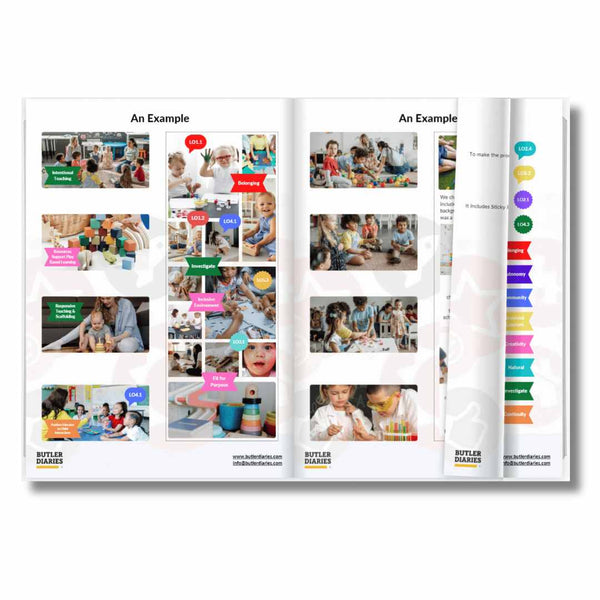
- images and samples into the evidence section of your reflection spread
The goal is to gather enough to make decisions — not enough to write a report. Not every piece of learning or experience needs to be recorded in your program. You use your professional judgement to record significant, quality learning that tells you something about the child and their learning.
Step 3 (As the week emerges): Analyse learning (Assess / Analyse)
This is where quality practice shows.
Instead of:
“They enjoyed it.”
Stronger analysis asks:
-
what learning is emerging?
-
what skills/dispositions are developing?
-
what patterns are forming?
-
what should be extended next?
As your week emerges, begin critically reflecting in your reflection spread as appropriate and needed (rather than in every box out of obligation). This ensures it remains fresh in your mind and that you are already collecting valuable data to help you program the next week. This turns “documentation” into professional decision-making.
Step 4 (End of week / Beginning of the following): Reflect & evaluate (Evaluate)
Reflection isn’t a summary. It’s evaluation. It's action.
Meaningful reflection includes:
-
what worked (and why)
-
what didn’t work (and why)
-
impact on children’s learning
-
next steps for planning
Finalise your critical reflections and use this data to start pre-planning for the following week.
Step 5 (Next week): Adjust planning based on reflection (Adjust)
This is the step many programs miss — and it’s also the step assessors want to see: responsiveness.
When your reflection leads to changes, you show:
-
continuous improvement
-
intentionality
-
evidence-informed planning decisions
It's important to remember a plan is just a guide. It is designed to change and evolve. Just because it's planned, doesn't mean it has to be done. This is how to approach that to show quality documentation.

Examples of Strong Weekly Reflection (that supports the planning cycle)
If reflection feels repetitive, it’s usually because it’s describing events rather than evaluating learning.
Example 1: Environment Reflection
Reflection:
“Children returned to the construction space daily and began collaborating more intentionally. Several children negotiated roles and persisted through structural challenges. Next week we will extend this by introducing bridge images and adding clipboards for children to sketch plans before building.”
Example 2: Intentional Teaching Reflection
Reflection:
“During group story experiences, some children disengaged during longer discussions. When we adjusted to shorter questioning with visual prompts, more children contributed. Next week, we will use smaller bursts and include more child-led retelling.”
Example 3: Wellbeing / Transitions Reflection
Reflection:
“Transitions remain challenging for two children. Visual countdowns and consistent transition roles reduced distress. Next steps: introduce a predictable transition song and implement one-to-one support during pack-up.”
How to Link to EYLF Without Overthinking It
Linking to EYLF outcomes should not feel forced.
The easiest method:
-
identify the learning you saw
-
match it naturally to the relevant outcome
Examples:
-
collaboration, inclusion, fairness → Outcome 1 / 2
-
persistence, confidence → Outcome 3
-
inquiry, problem-solving → Outcome 4
-
language, storytelling → Outcome 5
Start with learning first — outcomes second and remember, link to one or two main learning outcomes. This shows true understanding of the significant learning occuring rather than 'tick a box' links.
How to avoid getting stuck on the smaller details
Even when educators understand the planning cycle, the biggest ongoing struggle is:
“What do I write where?”
Uncertainty creates delays and second-guessing — which creates overwhelm. What to include in each box is not a test, there are no wrong answers. It is easy to think there is one way to complete the Weekly Programming and Reflection Diary when in fact, it is designed to be used differently across many services and educators. Here's What to Include in Each Programming Box (and Why There’s No “Wrong” Box).

Where the Weekly Programming & Reflection Diary Guide fits in
The Weekly Programming & Reflection Diary Guide supports educators with:
-
breaking down the Butler Method, bringing you back to simplicity instead of overwhelm
-
examples of educator wording for program + reflection and tips and tricks to strengthen compliance links and reduce documentation
-
how to build evidence without over-documenting
-
how to stay consistent week-to-week
It’s designed to remove the mental load and make the weekly cycle achievable.
Why Cycle of Planning Training (Professional Development) Helps Educators Program With Confidence
Our Weekly Programming & Reflection Diary Guide is designed to give you the knowledge you need to understand the Butler Method and document with simplicity. It eliminates over-documenting, stress, and overwhelm. After you understand your tool, you can expand on how to enhance compliance evidence.
Because sometimes even with a structured system, many educators still feel unsure about:
-
what “analysis” should look like
-
how the cycle of planning fits into your documentation at different points
-
how to prove intentionality with confidence
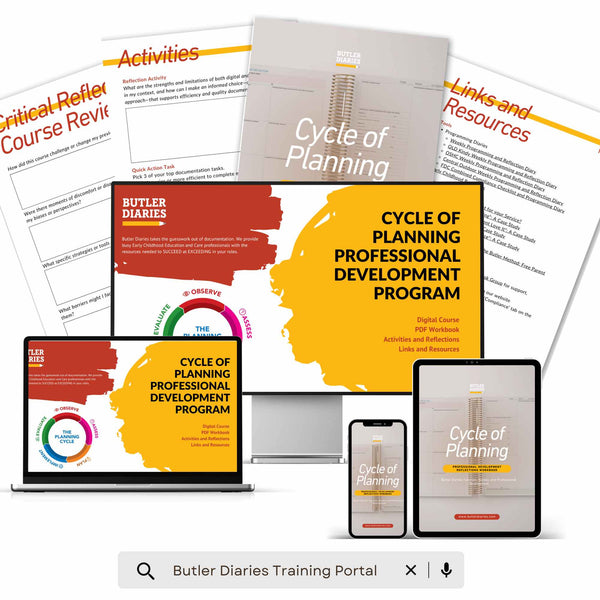
That’s why Cycle of Planning training (professional development) is so valuable.
The EYLF planning cycle is an established expectation of quality practice — and while many sector providers offer training specifically on implementing it, they leave it open ended which can sometimes leave you just as confused or lead to overdocumenting to try to achieve it.
Our Cycle of Planning training has been specifically designed to explore the cycle of planning from within the context of your Diary, ensuring each step is relevant, shown through examples, and practically fits into your everyday documentation.

What Cycle of Planning Professional Development can support:
A strong Cycle of Planning professional development training helps educators:
-
deeply understand each planning cycle stage
-
strengthen critical reflection (not just “what happened”)
-
improve evidence quality for QA1
-
confidently link learning to EYLF outcomes
-
apply the cycle in a realistic weekly structure
In short: training improves educator judgement, and the diary system helps educators apply it consistently. Together it simplifies and enhances your programming system.
How Butler Diaries Supports Both: Training + Weekly Implementation
Educators don’t need more pressure — they need clarity and support.
That’s why Butler Diaries provides both:
-
Cycle of Planning professional development training (the understanding + quality)
-
Weekly Programming & Reflection Diary Guide (the simplified system)
This supports educators to:
-
reduce programming overwhelm
-
strengthen reflective practice
-
build meaningful evidence over time
-
program with confidence (not confusion)
Quick Start Plan: a sustainable weekly cycle
If you’re feeling behind or burnt out, start here:
✅ Plan (Day 1): intentions + set-ups
✅ Observe (Daily): short notes + children’s quotes
✅ Analyse (Mid-week): what learning is emerging?
✅ Evaluate (End-week): what worked and why?
✅ Adjust (Next week): program from reflection
That routine is the Cycle of Planning in action — without the chaos and can naturally be followed by the design of your Weekly Programming and Reflection Diary — that is the Butler Method.
Final Thought: Good programming should protect educator wellbeing
Educators don’t struggle because they don’t care.
They struggle because the job is demanding — and without structure, programming expands endlessly.
A good system does two things:
-
strengthens outcomes for children
-
reduces documentation load for educators
That’s what the Cycle of Planning is meant to achieve.
FAQ on Weekly Programming & Reflection and Using the Cycle of Planning
What is Cycle of Planning training in Early Childhood Education and Care?
Cycle of Planning training is professional development that teaches educators how to implement the EYLF planning cycle in practice — including how to observe, analyse learning, plan intentionally, reflect meaningfully, and adjust future programming. A training like the Butler Diaries' Cycle of Planning professional development training explores the cycle within the context of a simplified and proven programming system.
Is the Cycle of Planning professional development useful for Assessment and Rating?
Yes. Quality evidence in QA1 relies on showing intentional planning, ongoing evaluation, and responsive adjustments — which is exactly what Cycle of Planning professional development strengthens. Many customers using the Butler Method of Programming and Reflection are rated exceeding thanks to their implementation of the cycle of planning within their Diaries.
How do I document the EYLF planning cycle without over-documenting?
Use a weekly routine where documentation happens briefly at each stage (observe/analyse/plan/implement/evaluate), instead of trying to write everything at the end. The key is clarity, not length. Utilise the support materials and training available at Butler Diaries.
Related Blog Posts