
The Most Valuable Part of Documentation Isn't the Document
Many educators see documentation as something they need to complete for compliance, but its greatest value may lie elsewhere. Discover how reflective writing supports professional thinking, critical reflection, intentional programming, and continuous improvement in Early Childhood Education and Care.

Why the thinking behind documentation matters more than the paperwork itself
Documentation has become one of the most debated topics in Early Childhood Education and Care.
How much is enough?
What should be documented?
What evidence will support Assessment and Rating?
How can educators reduce paperwork while still meeting requirements?
These are important questions. Yet they often focus on the final document rather than the purpose behind it.
The reality is that documentation was never intended to be a collection of forms, observations, displays, or folders. Documentation exists to support thinking.

The most valuable part of documentation is often not the document itself. It is the reflection, analysis, decision-making, and professional judgement that occur while creating it.
This idea aligns closely with the intent of the National Quality Framework, the Early Years Learning Framework (EYLF), and decades of research into reflective practice.
It also aligns with emerging research suggesting that the act of writing itself can support clearer thinking, emotional regulation, professional learning, and resilience.
Documentation Was Never Meant to Be About Paperwork
When educators become overwhelmed by documentation requirements, it is easy to view documentation as an administrative task.
Something to complete.
Something to store.
Something to show an assessor.
However, the EYLF positions documentation differently.
Documentation is intended to help educators:
-
notice children's learning
-
analyse learning over time
-
reflect on practice
-
plan future experiences
-
communicate with families
-
make informed professional decisions
The document is simply the evidence left behind after this thinking process has occurred.
Without the thinking, documentation becomes a record.
With the thinking, documentation becomes a tool for improving outcomes for children.

The Hidden Benefit of Writing
Recent research has highlighted something many educators instinctively know.
Writing is not simply a way of recording thoughts.
Writing is a way of processing thoughts. Research suggests that writing can help people organise experiences, make meaning from events, regulate emotions, and strengthen reflective thinking. Studies examining expressive writing have also found links between writing, wellbeing, emotional processing, and resilience.
This matters in Early Childhood Education and Care because much of what educators do every day requires professional judgement.
Consider the difference between these two examples:
Example One
"Children were not interested in group time today."
Example Two
"Several children left group time after five minutes. I wonder whether the length of the experience matched their current interests and developmental needs. This may indicate a need for smaller, more flexible group experiences."
The second example is not necessarily longer.
It is simply more reflective.
The value is not found in the words themselves.
The value is found in the thinking that occurred while writing them.
Reflection Creates Professional Growth
Research into reflective writing consistently shows that reflection helps individuals connect experiences, analyse outcomes, recognise patterns, and develop deeper understanding. Reflective writing has been linked to increased metacognition, which is the ability to think about and evaluate one's own thinking and decision-making processes.
This is exactly what effective critical reflection requires.
When educators engage in reflective practice, they move beyond asking:
"What happened?"
They begin asking:
-
Why did it happen?
-
What does this tell us about children's learning?
-
What assumptions might be influencing our decisions?
-
What could we do differently?
-
What should we continue doing?
These questions support continuous improvement because they focus on understanding rather than simply recording.

Why Quality Matters More Than Quantity
One of the most common misconceptions in documentation is that more evidence automatically demonstrates higher quality practice.
In reality, large amounts of documentation can sometimes hide a lack of analysis.
A service may have:
-
hundreds of observations
-
extensive displays
-
multiple portfolios
-
detailed planning documents
Yet still struggle to explain how those records informed practice.
Conversely, a concise observation followed by thoughtful reflection and intentional planning can demonstrate a clear cycle of learning.
This is why quality documentation is not measured by volume.
It is measured by the depth of thinking that informs it.
The strongest documentation often answers one simple question:
What did we learn from this information?
Documentation as a Thinking Tool
When documentation is viewed as a thinking tool rather than a compliance task, its purpose changes.
An observation becomes an opportunity to identify learning.
A reflection becomes an opportunity to evaluate practice.
A planning note becomes an opportunity to make intentional decisions.
A conversation with an Educational Leader becomes an opportunity to challenge assumptions and strengthen pedagogy.
The focus shifts from producing documents to using documents.
This distinction is subtle but powerful.

What This Looks Like in Practice
Imagine an educator notices that a group of children are repeatedly creating obstacle courses outdoors.
The observation itself is valuable.
However, the deeper value emerges when the educator begins documenting their thinking:
-
What skills are children demonstrating?
-
What interests are emerging?
-
How might this connect to learning outcomes?
-
What could extend this learning further?
-
What does this tell us about children's agency?
By recording these reflections, the educator creates a visible record of professional thinking.
This is where meaningful programming begins.
Supporting Reflective Thinking Through Everyday Documentation
One reason many educators continue to prefer paper-based reflection is that handwriting naturally slows the thinking process.
Rather than quickly typing information and moving on, writing encourages educators to pause, analyse, connect ideas, and process experiences more deeply. Research suggests that this slower, more deliberate process can support meaning-making and reflective thinking.
This is why many services use tools such as a Weekly Programming and Reflection Diary to capture observations, planning ideas, reflective notes, professional conversations, and ongoing evaluation.

The diary itself is not the goal.
The thinking it encourages is the goal.
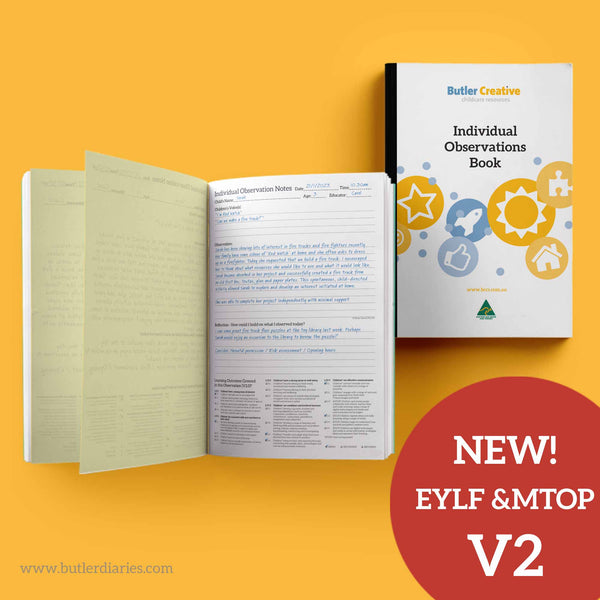
Similarly, educators often use an Individual Observation Duplicate Book to record observations as they happen. The value is not simply collecting observations. The value comes from later reviewing those observations, identifying patterns, and using them to inform programming decisions.
Documentation becomes significantly more powerful when it supports thinking rather than storage.
Making Learning Visible to Yourself
We often hear the phrase "making learning visible."
Usually, this refers to making children's learning visible to families, colleagues, or assessors.
But documentation also makes learning visible to educators themselves.
Without documentation, many valuable insights disappear.
Patterns remain unnoticed.
Questions remain unexplored.
Growth goes unrecognised.
Documentation creates opportunities to revisit experiences and view them with fresh perspective.
Sometimes the greatest value of a reflection is not what it says in the moment.
It is what it reveals six months later.
Moving Beyond Compliance
Assessment and Rating is important.
Compliance is important.
Evidence is important.
However, documentation becomes far more meaningful when it is viewed as a tool for professional learning rather than a task to complete.
The strongest evidence of quality practice is rarely found in the number of documents produced.
It is found in the professional thinking behind them.
When educators use documentation to question, analyse, evaluate, and improve practice, documentation becomes more than evidence.
It becomes part of the learning process itself.
Important Reminder
Documentation is not valuable because it fills a folder.
Documentation is valuable because it supports thinking.
The goal is not to create more paperwork.
The goal is to create meaningful opportunities to notice, reflect, analyse, and respond.
When documentation is approached with intention, the most valuable part is often not the document that remains.
It is the professional growth that occurred while writing it.
Related Articles