
10 Ways to Be Safer with Photographs in Early Childhood Education and Care
Recent updates across the sector — including strengthened Child Safe Standards and growing guidance around privacy — are prompting many services to reflect on how photographs of children are used in documentation. For years, photos have been a dominant form of “evidence”. But the conversation is shifting.

Rethinking documentation in line with child safety, privacy, and intentional practice
Recent updates across the sector — including strengthened Child Safe Standards and growing guidance around privacy — are prompting many services to reflect on how photographs of children are used in documentation.
For years, photos have been a dominant form of “evidence”. But the conversation is shifting.
It’s no longer about how many photos you take — it’s about why you take them, how they are used, and whether they are necessary at all.
This shift aligns strongly with:
-
Child Safe Standards (QLD now in effect from 1 January 2026)
-
National Quality Standard (particularly QA2 – Children’s Health and Safety, and QA7 – Governance and Leadership)
-
ACECQA guidance on privacy, dignity, and respectful practice
Below are practical, service-friendly ways to strengthen your approach.
1. Be Intentional — Not Automatic
Before taking a photo, pause and ask:
-
What learning am I capturing?
-
Why does this need a photograph?
-
Could this be documented another way?
Not every moment needs a visual record. Intentional teaching includes intentional documenting.
2. Reduce the Number of Photos Taken
More photos does not equal stronger documentation.
In fact, excessive photos can:
-
Increase privacy risks
-
Create unnecessary workload
-
Dilute meaningful evidence
Fewer, more purposeful images create clearer narratives.
3. Avoid Identifiable Features Where Possible
Consider:
-
Photos of hands engaging with materials
-
Over-the-shoulder perspectives
-
Back-of-head or partial images
This allows you to still capture engagement without compromising identity.

4. Check Consent — and Understand Its Limits
Even with parent/guardian consent:
-
Images must still be used respectfully
-
They should not expose children to risk
-
Use must align with your service’s policies
Consent is not a blanket approval for unlimited use.
5. Be Mindful of Context and Environment
Avoid photos that include:
-
Toileting or vulnerable routines
-
Distressed or emotional moments
-
Clothing changes or personal care
Children’s dignity must always come first.
6. Store and Share Securely
Ensure:
-
Digital platforms are secure and access-controlled
-
Printed documentation is not publicly visible
-
Photos are not stored on personal devices
This aligns with both privacy legislation and Child Safe expectations.
7. Avoid Over-Sharing in Displays
Consider what is displayed:
-
Limit large group displays with identifiable images
-
Avoid labelling full names with photos
-
Be cautious in shared or high-traffic areas
Ask: Who can see this?
8. Focus on the Learning — Not the Aesthetic
A common shift in the sector is moving away from “pretty” documentation.
Instead of:
-
Styled setups purely for photos
Focus on:
-
Genuine engagement
-
Real interactions
-
Authentic learning moments
The goal is not to create content — it’s to capture meaning.
9. Use Photos to Support, Not Replace, Documentation
Photos should:
-
Add context
-
Support observations
They should not replace:
-
Analysis
-
Reflection
-
Intentional planning
A photo without interpretation is not evidence — it’s just an image.
10. Explore Alternatives to Photographic Evidence
Some of the strongest documentation doesn’t involve photos at all.
Consider capturing:
-
Children’s voices (quotes and conversations)
-
Educator jottings and observations
-
Learning stories
-
Diagrams or mind maps
-
Children’s drawings or mark-making
-
Feedback from children or families
-
Annotated work samples
These forms often provide deeper insight into learning than a photo ever could.

Moving Forward: A Shift in How We Document Evidence
As practice evolves, so too should the tools that support it.
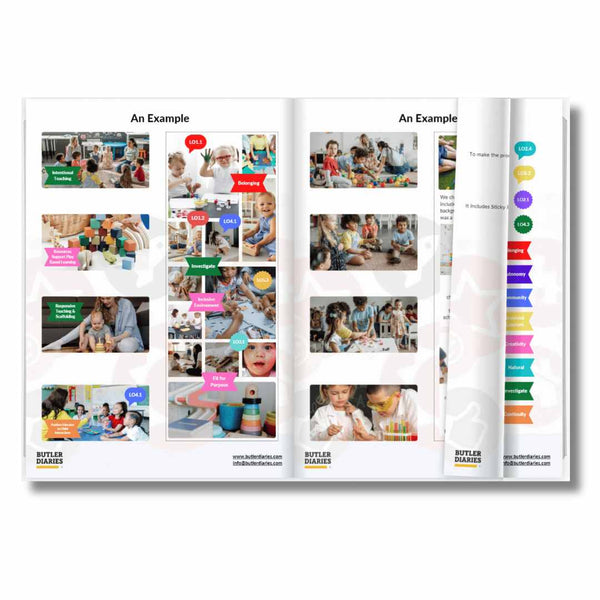
From the 2027 Weekly Programming and Reflection Diaries onwards, you’ll notice a deliberate change:
“Photographic Evidence of Learning Experiences” → “Evidence of Learning”
This is more than a wording update — it reflects a sector-wide shift.
What this means in practice:
Educators are supported to document learning through a broader, more meaningful lens, including:
-
Written observations and quick jottings
-
Children’s voice and direct quotes
-
Reflections and educator insights
-
Learning stories and narratives
-
Drawings, diagrams, and mark-making
-
Feedback loops with children and families
What this doesn't mean:
This doesn't mean you can no longer include photographs. When considering the safe practices in this article, your service policies, and your own reflections, you can still include children's photos in your Diary.
Why this matters:
-
Reduces over-reliance on photos only
-
Strengthens intentional teaching
-
Aligns with child safety and privacy expectations
-
Supports authentic, reflective documentation
-
Reduces workload while increasing quality
A Gentle Reframe for Educators
If you’ve ever felt pressure to:
-
Photograph every child, every day
-
Prove learning through images
-
Capture everything
This is your reminder:
You don’t need more photos.
You need clearer intention.
And often, the richest evidence of learning is found in:
-
what children say
-
what they do repeatedly
-
how they think
-
how you respond
Final Reflection
Strong documentation is not about visibility — it’s about meaning.
By being more thoughtful with photographs and embracing broader forms of evidence, services can:
-
Better protect children
-
Strengthen compliance
-
Improve the quality of programming and reflection
And ultimately, create documentation that truly reflects children’s learning — not just what it looked like in a moment.
Related Articles
- QLD Child Safe Standards in Early Childhood Education and Care
-
Upcoming Child Safety Regulations – What ECEC Services Need to Know by 1 September 2025
-
Ultimate Guide to Incident Reporting in Childcare
-
NQS 2026 Updates and 2025 Policy Guidelines: Downloadable Resources
-
What counts as evidence of learning (with examples mapped to EYLF)