
The Butler Method Is Not a Pedagogy - Here's What It Actually Does
The Butler Method isn’t a pedagogy — it’s a way to make your practice visible. Learn how to move beyond activities and document children’s learning, thinking, and progression in a way that aligns with EYLF v2.0 and the National Quality Standard.

A common question we hear is whether the Butler Method reflects a specific teaching approach.
The short answer is — it doesn’t.
The Butler Method is not a pedagogy. It does not ask you to change how you teach, plan, or engage with children. Instead, it provides a clear, structured way to make your existing practice visible.
Whether your approach aligns with slow pedagogy, inquiry-based learning, Reggio-inspired practice, Montessori, or play-based learning, the Butler Method supports you to capture the thinking behind your decisions, not just the experiences themselves.
Moving Beyond Activities: What the Butler Method Is Really Showing
One of the biggest challenges educators face is translating rich practice into documentation that doesn’t feel surface-level.
Programming can easily become a list of:
- painting
- water play
- outdoor play
But strong practice in Early Childhood Education and Care reflects:
- children’s emerging ideas
- developing theories
- dispositions for learning
- ongoing investigations
The Butler Method helps make this visible by structuring documentation around the cycle of planning:
- Assess — What are children showing us?
- Plan — How are we responding?
- Implement — What is happening in practice?
- Reflect — What did we notice, and what does it mean?
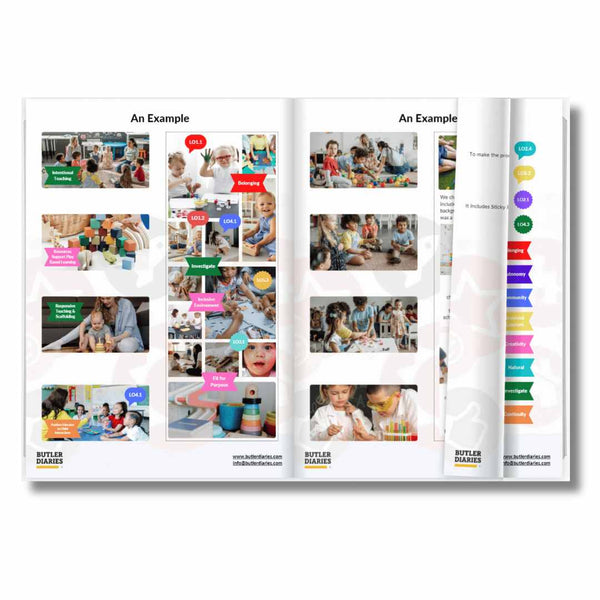
Using the Weekly Programming and Reflection Diary, this cycle becomes visible across:
- the program page (planning and response)
- the reflection page (analysis and progression)
This shifts the focus from:
-
“What activities did we do?”
to - “What learning is unfolding, and how are we responding?”

What This Looks Like in Practice
Instead of documenting:
- “Water play activity”
Using the Butler Method, an educator might document:
- Program: children exploring flow, movement, and cause and effect through water
- Intentional Teaching Extension: introduced funnels and tubing to extend exploration
- Reflection: children began predicting how water would move and adjusted their approach
This example shows:
- the learning
- the educator decision-making
- the progression
Not just the activity.
Intentional Teaching Is Not a Lesson Plan
A key area of confusion is how intentional teaching is interpreted.
Intentional teaching does not mean:
- delivering group lessons
- teaching set content
- running structured sessions
It is about purposeful, responsive decision-making.
This might look like:
- adding resources to extend play
- asking questions that deepen thinking
- modelling language or problem-solving
- adjusting the environment to support exploration
Within the Weekly Programming and Reflection Diary, every box prompt can be used to show:
- educator decisions
- reasoning behind those decisions
- how learning is being supported
Not a script of what was “taught”.

The Cycle of Planning Is Not Always Weekly
Another common concern is the idea that the cycle of planning must be completed each week.
In practice, learning:
- continues
- evolves
- is revisited over time
The Butler Method supports educators to:
- carry learning across multiple weeks
- revisit ideas
- track progression
The weekly layout is simply a recording structure, not a limitation. It prompts regular critical review that supports growth and deep learning as it unfolds.
Many educators use bookmarks within the diary to:
- track ongoing investigations
- move between program and reflection
- keep continuity visible
Evidence of Learning Goes Beyond Photos
There is increasing awareness across the sector that learning is not always best captured through photographs alone.
The Butler Method supports a broader understanding of evidence, including:
- children’s voice (captured in your program, observations, and the Children’s Voices Diary)
- educator observations (recorded in the Individual Observation Duplicate Book)
- reflections and analysis inside your Weekly Programming and Reflection Diary
- drawings, diagrams, and representations also in your Programming Diary
For services still incorporating photos, the Programming and Reflection Printer Pack can support clear, intentional linking of visual evidence to learning — rather than using photos without purpose.
The focus remains on:
- what children are learning
- how that learning is demonstrated

Maintaining Confidentiality in Programming
Programming is often visible to families, which means documentation must maintain confidentiality.
Your Weekly Programming and Reflection Diary is designed to be on display. You can use:
- Initials to track individual learning
- Codes to link to individual learning and goals from the Individual Observation Duplicate Book and Children’s Voices Diary
- Our Notebooks for behavioural or confidential information
Rather than identifying individual children within the program.
A Flexible Approach That Supports Your Pedagogy
At its core, the Butler Method is designed to support — not replace — your pedagogy.
It allows educators to:
- document depth instead of surface-level activities
- show how learning develops over time
- make intentional teaching visible
- align with the Frameworks v2.0 and National Quality Standard
Importantly, it supports a range of documentation tools working together. This creates a system where:
- observations inform programming
- programming reflects learning
- reflection shows progression

Where This Series Is Heading
This article is the starting point.
In the following articles, we’ll explore how the Butler Method supports different pedagogical approaches, including:
- slow pedagogy
- inquiry-based learning
- Reggio-inspired practice
- Montessori
- play-based learning
Each will focus on how to document:
- depth
- continuity
- intentionality
In a way that reflects how you already work.
Final Thought
Strong practice has never been about how many experiences are planned.
It is about how deeply we understand children’s learning — and how thoughtfully we respond.
The Butler Method is simply a way to make that visible.
Related Articles