
Play-Based Learning - Moving Beyond Activities
Still documenting play as a list of activities? Learn how to capture real learning, children’s voices, and intentional teaching within play using the Weekly Programming and Reflection Diary.

Play-based learning is the foundation of quality practice in Early Childhood Education and Care.
It supports children to:
- explore ideas
- build relationships
- solve problems
- develop language
- make sense of their world
Yet when it comes to documentation, play is often reduced to a list of activities.
This is where programs begin to lose depth.
The Butler Method supports educators to move beyond this by focusing on:
- what children are learning through play
- how educators are responding
- how learning develops over time
Play Is the Context for Learning — Not the Activity
In play-based learning, the experience itself is not the outcome.
It is the context where learning happens.
For example:
- dramatic play is not just pretending
- block play is not just building
- outdoor play is not just movement
Each of these supports:
- communication
- collaboration
- problem-solving
- identity development
Using the Weekly Programming and Reflection Diary, this means shifting from:
- naming the activity
to:
- identifying the learning within the play
The Shift: From Activities to Learning
A common pattern in programming is to list:
- home corner
- painting
- outdoor play
While these experiences occur, they don’t show:
- what children are learning
- how their thinking is developing
- how educators are supporting that learning
Using the Butler Method, educators can document:
- the purpose of play opportunities
- the learning being supported
- the decisions made in response to children

What This Looks Like in Practice
Play-based learning often involves rich social and imaginative scenarios.
For example:
- Program: Cafe dramatic play: taking on roles, creating menus, and interacting with peers
- Intentional Teaching: introduced writing materials for menus and orders, modelled language for turn-taking and negotiation
- Program: children began organising roles independently, using more complex language, and sustaining play scenarios for longer periods
This example shows:
- social development
- communication
- symbolic play
Not just “home corner play”.
Using the Program Page to Reflect Play-Based Learning
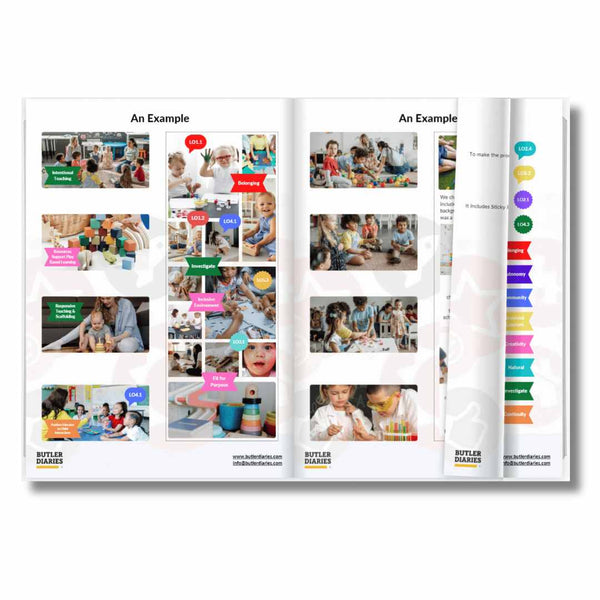
Within the Weekly Programming and Reflection Diary, educators can document:
Play Opportunities
- What environments are available
- How they support different types of play
Learning Focus
- What skills or concepts are being developed
Children’s Engagement
- What children are drawn to
- How they are interacting
This ensures the program reflects:
- the richness of play
- not just the presence of it
Capturing Learning Within Play
To show depth, educators can draw on:
- the Children’s Voices Diary to capture conversations and language
- the Individual Observation Duplicate Book for detailed observations
- Reflection pages to analyse learning and progression
These tools work together to show:
- what children are learning
- how play is evolving
- how educators are responding

Intentional Teaching Within Play
Intentional teaching is a key part of play-based learning.
It does not interrupt play — it strengthens it.
Educators may:
- introduce new materials
- model language
- support problem-solving
- guide social interactions
Within the Weekly Programming and Reflection Diary, this is documented as:
- educator decisions
- reasoning behind those decisions
- how learning was supported
One Experience Can Hold Multiple Layers of Learning
A single play experience can support multiple areas of development.
For example, the café scenario may involve:
- communication
- early literacy
- numeracy (money, counting)
- social negotiation
Documenting this depth shows:
- complexity
- intentionality
- meaningful learning
Document the learning in your program prompts to show the learning unfolding.
Revisiting Play Builds Depth
Play is not meant to change constantly.
Children benefit from:
- revisiting scenarios
- refining roles
- deepening understanding
Using the Butler Method, educators can:
- continue play themes across days or weeks
- document changes in complexity
- show progression over time

You Don’t Need to Fill Every Box
A strong play-based program may:
- focus on a few meaningful play opportunities
- revisit the same experiences
- leave some sections intentionally open
This reflects:
- responsiveness
- intentionality
- depth
Aligning with EYLF v2.0 and the National Quality Standard
Play-based learning aligns across all outcomes of the EYLF v2.0, particularly:
- Outcome 1: Identity
- Outcome 3: Wellbeing
- Outcome 4: Learning
- Outcome 5: Communication
The Butler Method supports educators to:
- make learning visible within play
- document intentional teaching
- show the cycle of planning
Providing strong evidence for:
- QA1: Educational program and practice
Play-Based Learning Requires Intentionality
There can be a misconception that play-based learning is less structured.
In reality, it requires:
- careful observation
- thoughtful decision-making
- deep understanding of children
The Butler Method helps make this visible.
Final Thought
Play is not just something children do.
It is how they learn.
When documentation focuses only on activities, it misses the depth of what is happening.
The Butler Method supports educators to document:
- the learning within play
- the decisions behind it
- the progression over time
So your program reflects the richness of play — not just a list of experiences.
Related Articles