
Reggio Emilia-Inspired Practice and the Weekly Programming and Reflection Diary
Looking to document Reggio Emilia–inspired practice more meaningfully? Learn how to capture children’s theories, thinking, and learning using the Weekly Programming and Reflection Diary.

Reggio Emilia–inspired practice places children’s ideas, theories, and questions at the centre of learning.
It values:
- children as capable and competent learners
- relationships and collaboration
- the environment as the third teacher
- documentation as a tool for thinking and interpretation
For many educators working in this way, traditional programming formats can feel restrictive — particularly when they appear to focus on activities rather than the process of learning.
The Butler Method supports Reggio-inspired practice by helping educators document:
- how ideas emerge
- how they develop over time
- how educators interpret and respond
Programming as an Emergent Process
In Reggio-inspired practice, programming is not pre-determined.
It emerges from:
- children’s conversations
- their questions and theories
- shared experiences
- ongoing investigations
This means programming is:
- flexible
- responsive
- continuously evolving
Using the Weekly Programming and Reflection Diary, educators can document:
- emerging ideas rather than fixed plans
- evolving directions rather than completed activities
- learning as it unfolds

Capturing Children’s Theories and Ideas
Children are constantly forming theories about the world.
These might relate to:
- how things work
- relationships between people and environments
- cause and effect
- identity and belonging
Capturing this thinking is central to Reggio-inspired documentation.
Educators can use:
- the Children’s Voices Diary to record conversations and theories
- the Individual Observation Duplicate Book to capture deeper observations
- the program page to reflect shared patterns and ideas
The program becomes a key space to document:
- what children are expressing
- what they are testing
- what they are returning to
What This Looks Like in Practice
In a Reggio-inspired approach, documentation focuses on interpreting meaning — not just recording events.
For example:
-
Program:
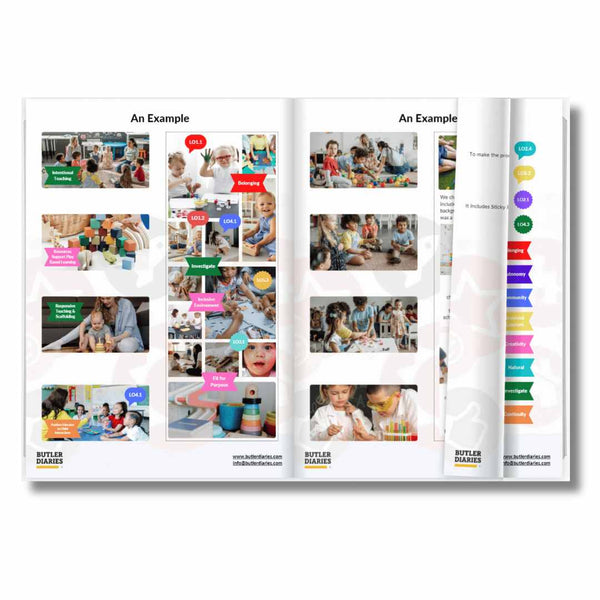
- Wellbeing/Mindfulness box: Children exploring identity through self-portraits using mirrors, drawing materials, and loose parts
- Children’s Voices: “My hair is different today”, “I have two eyes like my mum”
-
Intentional Teaching:
- Group Learning/Intentional Teaching box: Introduced a variety of mirrors and collage materials to support different representations and perspectives
This example shows:
- children’s theories about identity
- symbolic representation
- evolving understanding
Not just the experience of drawing.
The Role of Intentional Teaching in Reggio-Inspired Practice
Intentional teaching within this approach is not separate from learning — it is embedded within it.
Educators respond by:
- listening closely
- interpreting children’s thinking
- making thoughtful decisions about how to extend learning
This might include:
- introducing new materials
- adjusting the environment
- revisiting ideas
- offering alternative ways to represent thinking
Within the Diary, this is documented as:
- educator decisions
- interpretation of children’s ideas
- connections to learning
The programming prompt boxes can be used to capture these intentional teaching strategies.

The Environment as the Third Teacher
In Reggio-inspired settings, the environment plays an active role in learning.
Changes to the environment are intentional and responsive.
This might include:
- rearranging spaces
- adding or removing materials
- creating invitations to explore
Within the Weekly Programming and Reflection Diary, educators can document:
- environmental changes as part of the program
- how these changes respond to children’s ideas
- how they support ongoing investigations
Any prompt box can feature a change in the environment or record children's interactions with it.
Reflection as Interpretation, Not Summary
Reflection in Reggio-inspired practice goes beyond describing what happened.
It involves:
- analysing children’s thinking
- identifying patterns and themes
- interpreting meaning
Educators might reflect on:
- What are children trying to understand?
- What theories are emerging?
- How has thinking shifted?
This transforms documentation into:
- a tool for professional thinking
- a record of learning journeys
Showing Learning Over Time
Reggio-inspired practice values continuity.
Ideas are revisited, expanded, and reinterpreted.
Using the Butler Method, educators can:
- revisit the same investigation across weeks
- link reflections over time
- build on previous documentation
This creates a clear picture of:
- progression
- depth
- sustained engagement
Aligning with EYLF v2.0 and the National Quality Standard
Reggio-inspired practice aligns strongly with:
- Outcome 1: Identity
- Outcome 2: Connection
- Outcome 4: Learning
- Outcome 5: Communication
The Butler Method supports educators to:
- make learning visible
- document intentional teaching
- show the cycle of planning
This provides strong evidence for:
- QA1: Educational program and practice
You Don’t Need to Pre-Fill the Program
A key shift when using the diary within Reggio-inspired practice is letting go of the idea that the program must be fully planned in advance.
Instead:
- documentation can be added as learning unfolds
- the program becomes a working document
- ideas emerge throughout the week
This reflects authentic emergent curriculum.

Final Thought
Reggio Emilia–inspired practice is not about following a set method.
It is about:
- listening deeply
- interpreting meaning
- responding with intention
The Butler Method supports this by helping educators document:
- children’s theories
- their own professional thinking
- how learning develops over time
So the program reflects not just what happened — but what it meant.
Related Articles