
How to Show Learning Over Time
Are your programs showing weekly snapshots or real learning over time? Learn how to document progression, continuity, and deeper learning using the Butler Method.

One of the most common challenges in documentation is showing how learning develops over time.
Many programs capture:
- what happened this week
- what children did in the moment
But they don’t always show:
- how learning is progressing
- how ideas are developing
- how children’s thinking is changing
This can make documentation feel disconnected — like a series of weekly snapshots rather than a continuous learning journey.
The Butler Method supports educators to move beyond this by making learning over time visible.
Why Learning Over Time Matters
Children’s learning is not immediate or linear.
It develops through:
- revisiting experiences
- testing ideas
- refining understanding
- building on prior knowledge
When documentation shows learning over time, it demonstrates:
- depth
- continuity
- progression
This aligns strongly with the EYLF v2.0 and provides clear evidence for QA1: Educational program and practice.
From Snapshots to Learning Journeys
A weekly program can sometimes appear as:
- separate entries
- disconnected experiences
- isolated observations
To show learning over time, the focus needs to shift from:
- individual moments
to:
- ongoing journeys
Instead of replacing learning each week, educators can:
- continue investigations
- revisit ideas
- build on previous documentation
The reflection spread is designed to help you continue and extend on this learning.

What This Looks Like in Practice
Learning often becomes clearer when viewed across time.
For example:
Week 1
- Program: children exploring ramps and rolling objects
- Intentional Teaching: introduced different surfaces and angles
- Reflection: children showed curiosity about speed and movement
Week 2
- Program: revisiting ramps with added materials to change height and texture
- Children’s Voices: “This one goes faster”, “It’s slower here”
- Intentional Teaching: encouraged prediction and comparison
- Reflection: children began comparing speed and adjusting ramp positions
Week 3
- Program: extending ramp exploration into building their own structures
- Intentional Teaching: introduced blocks and connectors to create stable ramps
- Reflection: children combined prior knowledge to design more complex setups and test outcomes
This example shows:
- progression
- increasing complexity
- connection between experiences
Not three separate weekly plans.
You can use tools like coding and adding a date by the experience to help link each step in the cycle of planning and help make the learning visible over multiple weeks.

Recognising When Learning Is Continuing
Learning is ongoing when children:
- return to the same experience
- refine their approach
- build on previous ideas
- demonstrate increased confidence or complexity
These are signs that learning is:
- developing
- not complete
Using the Diary to Link Learning Across Weeks
The Weekly Programming and Reflection Diary supports continuity when used intentionally.
Educators can:
- continue the same learning focus across weeks
- reference previous observations
- build on earlier reflections
Practical strategies include:
- noting experiences that are continuing from the previous week with a code or date
- linking reflections to prior learning and planning for ongoing learning
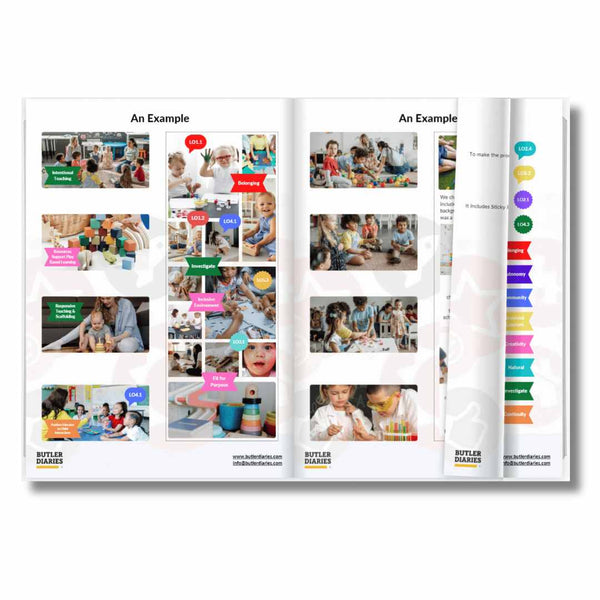
- using bookmarks, stickers, or colour coding to track ongoing investigations

Capturing Progression Through Supporting Tools
A strong documentation system helps track learning over time.
Educators can use:
- the Individual Observation Duplicate Book to capture ongoing development
- the Children’s Voices Diary to track evolving conversations
- the Weekly Programming and Reflection Diary to show shared learning and progression
This creates a clear connection between:
- observation
- planning
- reflection
Reflection: Tracking Change Over Time
Reflection is where progression becomes visible.
Rather than documenting:
- what happened
Reflection should capture:
- what has changed
- what has deepened
- what children now understand
Educators might consider:
- Are children using more complex language?
- Are they solving problems more independently?
- Are they making stronger connections?
Intentional Teaching Across Time
Intentional teaching develops over time.
Educators may:
- introduce strategies
- adjust their approach
- respond differently as learning evolves
Documenting this shows:
- professional decision-making
- responsiveness
- impact on learning
One Learning Focus Can Span Multiple Weeks
A strong program may:
- focus on one or two key ideas
- revisit them across multiple weeks
- deepen understanding over time
This reduces pressure to:
- constantly introduce new experiences
And better reflects how children learn.

Aligning with EYLF v2.0 and the National Quality Standard
Showing learning over time supports:
- Outcome 4: Children are confident and involved learners
- Outcome 5: Children are effective communicators
It also provides strong evidence for:
- QA1: Educational program and practice
You Don’t Need to Start Fresh Each Week
A key shift for educators is recognising:
You are not starting over each week.
You are continuing:
- ideas
- investigations
- learning
The Butler Method supports this continuity.
Final Thought
Learning is not made up of isolated moments.
It is a process that unfolds over time.
When documentation captures this, it shows:
- depth
- progression
- meaningful engagement
The Butler Method supports this by helping you document:
- where learning begins
- how it develops
- where it leads
So your program reflects a journey — not just a snapshot.
Related Articles