
What Intentional Teaching Actually Looks Like
Confused about intentional teaching? It’s not a lesson. Learn how to recognise, document, and show intentional teaching in everyday practice using the Weekly Programming and Reflection Diary.

Intentional teaching is one of the most discussed — and most misunderstood — concepts in Early Childhood Education and Care.
It is often interpreted as:
- group lessons
- teaching specific content
- structured, sit-down experiences
But this is not what intentional teaching means within the EYLF v2.0 or the National Quality Standard.
Intentional teaching is about being deliberate, purposeful, and thoughtful in your decisions — within everyday moments.
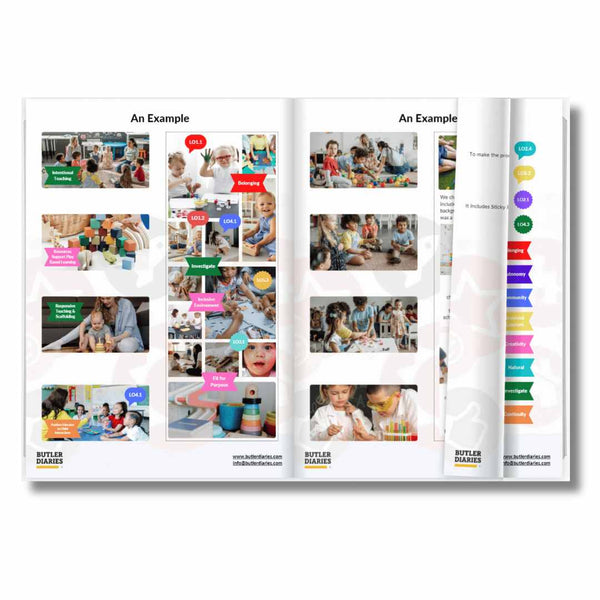
The Butler Method supports educators to make this visible, without needing to change how they work.
What Intentional Teaching Is — and What It Isn’t
Intentional teaching is not:
- delivering lessons
- stopping play to teach
- following a scripted plan
Intentional teaching is:
- responding to children’s ideas
- extending learning in the moment
- making decisions based on observation
- guiding thinking without taking over
It happens:
- during play
- in conversations
- through the environment
- in spontaneous moments
Why It Can Be Difficult to Document
Intentional teaching can feel difficult to document because it is:
- subtle
- responsive
- often unplanned
Educators are already doing it — but it can be hard to show:
- what was done
- why it was done
- how it supported learning
The Butler Method provides a structure to make this visible.
What This Looks Like in Practice
Intentional teaching often happens in small, everyday moments.
For example:
- Program recorded under 'Children's Spontaneous Choices': C.B. & T.M. Building with blocks, attempting to create stable structures
- Intentional Teaching recorded under 'Cognitive/Language': C.B. & T.M. Building blocks: Asked “What could you do to stop it falling?”, modelled placing a wider base, then stepped back
- Reflection recorded under Final Column, 'Intentional Teaching Box' or Reflection Spread: children began adjusting their structures independently, testing different approaches and persisting for longer
This example shows:
- guidance without taking over
- problem-solving being extended
- independence being supported
Not a formal teaching moment.

Using the Diary to Make Intentional Teaching Visible
Within the Weekly Programming and Reflection Diary, the intentional teaching section is not only for structured group times.
It can be used to document:
- educator decisions
- reasoning behind those decisions
- how learning was supported
Educators might record:
- introduced new materials
- asked open-ended questions
- modelled language
- adjusted the environment
This captures the thinking behind practice.
Intentional Teaching Through the Environment
Not all intentional teaching is verbal.
Many decisions are made through the environment.
For example:
- adding resources to extend an idea
- rearranging spaces to support engagement
- simplifying an area to reduce overwhelm
These are all intentional teaching decisions.
They can be documented within:
- the program page
- intentional teaching section
- reflection page
Linking Intentional Teaching to Learning
Intentional teaching should always connect to learning.
Educators can document:
- what learning was being supported
- how the response aligned with EYLF outcomes
For example:
- supporting problem-solving (Outcome 4)
- extending communication (Outcome 5)
- building confidence (Outcome 1)
This strengthens both:
- documentation
- compliance evidence
Reflection: Was It Effective?
Reflection allows educators to evaluate intentional teaching.
They might consider:
- Did the strategy support learning?
- Did it extend thinking?
- Should something different be tried next time?
This keeps the cycle of planning:
- active
- responsive
- ongoing
Here are more tips for reflecting on intentional teaching.

You Don’t Need a ‘Teaching Moment’
A key shift is recognising that intentional teaching is already happening.
It does not need to be added.
It needs to be:
- recognised
- understood
- documented
The Butler Method supports this shift.
Aligning with EYLF v2.0 and the National Quality Standard
Intentional teaching is embedded throughout the EYLF v2.0 and supports:
- Outcome 4: Learning
- Outcome 5: Communication
It is also central to:
- QA1: Educational program and practice
Documenting intentional teaching clearly provides strong evidence of:
- professional practice
- purposeful decision-making
Final Thought
Intentional teaching is not about doing more.
It is about being aware of what you are already doing.
When documented well, it shows:
- the depth of educator thinking
- the responsiveness of practice
- the connection between actions and learning
The Butler Method helps make this visible.
Related Articles