
EYLF-Aligned Daily Scheduling Strategies
Daily schedules are a vital part of EYLF-aligned programs, turning everyday routines into meaningful learning opportunities. This article includes practical EYLF-aligned scheduling tips to balance structure and flexibility, link routines to learning outcomes, and involve families and community.

The Early Years Learning Framework (EYLF), Australia's national curriculum for children aged birth to five, was updated in early 2023 to Version 2.0 of Belonging, Being and Becoming. This update prioritises flexible, child-centred programming, integrating Aboriginal and Torres Strait Islander perspectives and shifting towards "cultural responsiveness". Daily schedules are a vital part of EYLF-aligned programs, turning everyday routines into meaningful learning opportunities.
Key takeaways for EYLF-aligned schedules include:
- Flexible structure: Balance consistency with adaptability to children's interests and developmental needs.
- Child-focused planning: Design schedules with children, not for them, by incorporating their voices and interests.
- EYLF outcomes integration: Link daily routines like meals, play, and transitions to EYLF outcomes for learning and development.
- Family and community input: Use family updates and cultural contexts to personalise routines and strengthen connections.
- Documentation tools: Use resources like Butler Diaries to simplify compliance with EYLF and National Quality Standards.
EYLF-aligned schedules combine intentional teaching with child-led play, ensuring every moment - from nappy changes to group activities - supports learning outcomes. Practical tools and reflection processes help educators maintain compliance while responding to children’s evolving needs.

Building Blocks of an EYLF-Aligned Daily Schedule
An EYLF-aligned schedule weaves everyday moments - like greetings, play, and mealtimes - into a curriculum that not only meets compliance requirements but also enriches children's learning experiences. The key components of an effective daily schedule include arrival and transition routines, play-based learning with intentional teaching, and meals, rest, and quiet time. These elements help children feel secure, explore their interests, and develop lifelong skills.
Arrival and Transition Routines
The way children are welcomed sets the tone for their entire day. Personalised greetings create a sense of belonging and show children they are valued members of the group. This sense of inclusion is essential for aligning daily routines with EYLF outcomes.
"When children feel they belong, they develop strong relationships, a sense of identity, and the security to explore and engage in their environment." - ABC School Supplies
Transitions, much like arrivals, deserve thoughtful attention. Drop-off conversations with families are a chance to learn about recent events, changes at home, or new interests. For example, if a parent mentions a child’s family is moving house, you could integrate that topic into group discussions or imaginative play to help the child feel supported. Displaying photos and materials that represent the diverse backgrounds of children and incorporating home languages into everyday interactions further strengthens inclusion.

Play-Based Learning and Intentional Teaching
Balancing child-led play with educator-guided activities is a cornerstone of an EYLF-aligned schedule. Child-led planning involves listening to children’s voices and building the day’s activities around their spontaneous interests, while linking these experiences to EYLF outcomes. Observing children during play allows educators to scaffold learning effectively.
Short, small-group sessions (10–15 minutes) work well for intentional teaching, while uninterrupted playtime of at least 60 minutes fosters deeper engagement. Whole-group activities, on the other hand, should be kept brief - 15–20 minutes is ideal to maintain focus.
"Dynamic programming... is about creating flexible, adaptive, and child-driven learning experiences that evolve with the children's interests, needs, and developmental stages." - Aussie Childcare Network
Even routine tasks like nappy changes or getting dressed can become learning opportunities. These moments can be used to build vocabulary and social skills by naming objects, discussing what’s happening, and encouraging conversation. Such strategies naturally lay the groundwork for age-specific programming and documentation, which will be explored further in the next sections.

Meals, Rest, and Quiet Time
Daily routines like meals and rest are not just practical necessities - they are essential for emotional and social wellbeing. These moments encourage children to focus on the present, contributing to their sense of being. Mealtimes, for instance, create opportunities for social interaction, where children practise sharing, taking turns, and connecting with peers.
Quiet areas, designed with materials that reflect children’s backgrounds, offer comfort during rest periods. These familiar and calming spaces help children regulate their emotions and feel secure. Observing how children respond to these routines and adjusting the environment or timing to suit individual needs ensures these moments are meaningful. Treating meals and rest as integral parts of the educational program supports compliance and sets the stage for the next discussion on sample daily schedules.
Sample Daily Schedules by Age Group
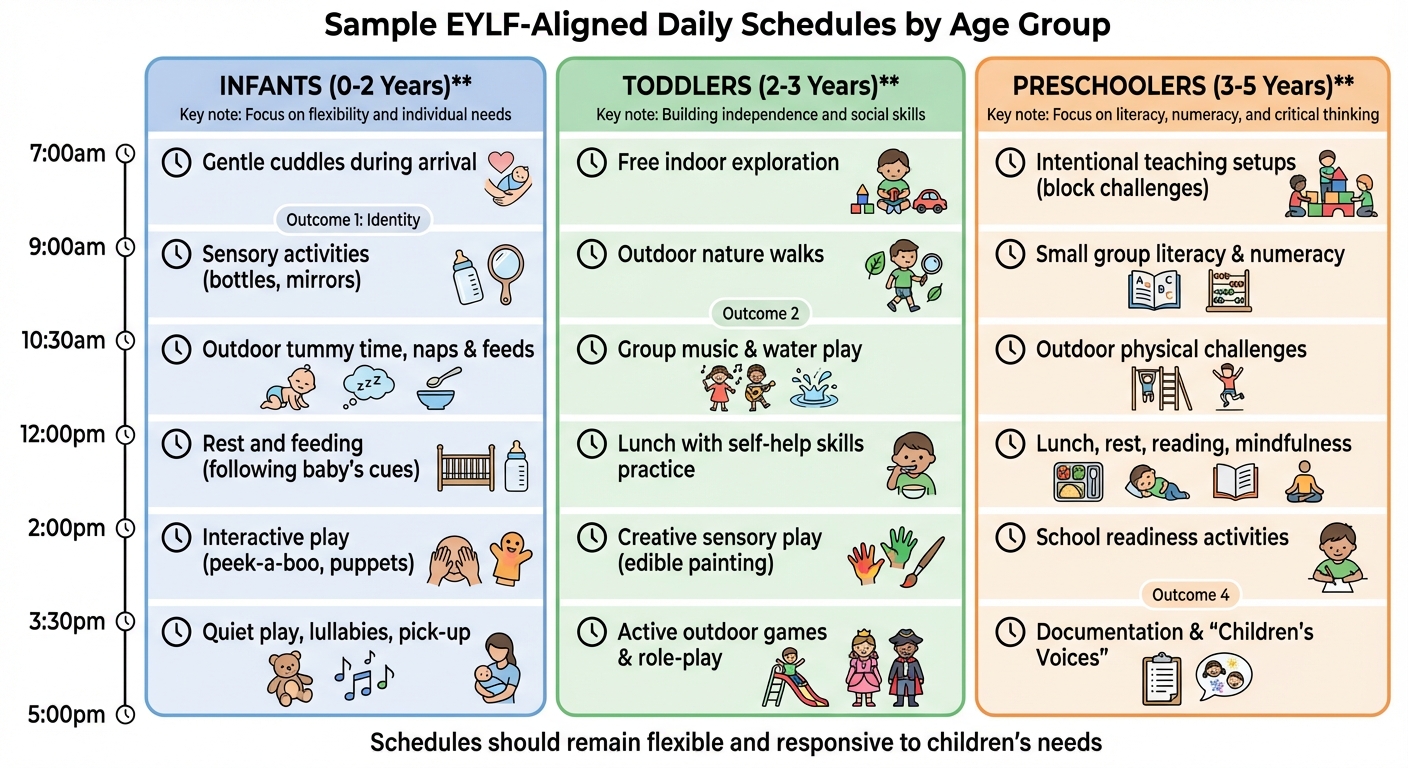
EYLF Daily Schedule Guide by Age Group: Infants, Toddlers, and Preschoolers
Understanding the developmental needs of infants, toddlers, and preschoolers is key to creating schedules that work for them. A consistent daily routine not only helps children feel secure but also supports their growing sense of independence. Below are examples of how daily plans can be tailored to suit different age groups, while also aligning with EYLF outcomes.
Infants (0-2 Years)
For infants, flexibility is the name of the game. Their schedules revolve around individual feeding and sleeping patterns, helping nurture secure attachments with carers. Instead of rigid timelines, the focus is on routines that adapt to each baby's needs.
- 7:00am–9:00am: Gentle cuddles during arrival time help infants feel safe and build bonds - an important step in developing a strong sense of identity (Outcome 1).
- 9:00am–10:30am: Sensory activities, like playing with sensory bottles or mirrors, stimulate exploration and curiosity.
- 10:30am–12:00pm: Outdoor tummy time encourages physical development, with naps and feeds following each baby's cues.
- 12:00pm–2:00pm: Rest and feeding continue, guided by hunger and sleep signals.
- 2:00pm–3:30pm: Interactive activities like peek-a-boo and finger puppets foster social connections.
- 3:30pm–5:00pm: The day ends with quiet indoor play and soothing lullabies as families arrive for pick-up.
Your program will be largely routine based with fewer experiences offered for longer periods of time. This is age appropriate EYLF programming. Here are more tips for programming for babies.
Toddlers (2-3 Years)
Toddlers thrive on routines that encourage independence and social skills. Predictable schedules help them navigate transitions and build confidence.
- 7:00am–9:00am: Arrival time offers opportunities for free indoor exploration, letting toddlers choose their activities.
- 9:00am–10:30am: Outdoor nature walks introduce them to the garden and natural materials, supporting Outcome 2: Children connect with their world.
- 10:30am–12:00pm: Group music sessions with instruments and water play combine creativity with safe exploration.
- 12:00pm–2:00pm: Lunch becomes a chance to practise self-help skills, like serving food or tidying up.
- 2:00pm–3:30pm: Creative play takes centre stage with sensory activities like edible finger painting.
- 3:30pm–5:00pm: Active outdoor games and role-play scenarios strengthen social bonds and teamwork.
Preschoolers (3-5 Years)
Preschoolers' schedules focus on building skills in literacy, numeracy, and science through planned activities. These routines also encourage critical thinking and collaboration.
- 7:00am–9:00am: Arrival time includes intentional teaching setups, like block-building challenges, to spark problem-solving.
- 9:00am–10:30am: Small group activities blend literacy and numeracy, such as scavenger hunts or painting letters.
- 10:30am–12:00pm: Outdoor play offers space for physical challenges, boosting confidence through risk-taking.
- 12:00pm–2:00pm: After lunch, children can rest, read quietly, or engage in mindfulness activities.
- 2:00pm–3:30pm: School readiness activities, like group discussions, align with Outcome 4: Children are confident and involved learners.
- 3:30pm–5:00pm: The day wraps up with documenting their learning through "Children's Voices", giving kids a chance to share their perspectives before heading home.

How to Keep Schedules Flexible and Responsive
The EYLF describes curriculum as encompassing all interactions, experiences, routines, and events - whether planned or unplanned. This means your daily schedule should act as a flexible framework rather than a rigid timetable. By allowing room for spontaneity, you can adapt to children's changing needs while maintaining enough structure to meet compliance standards and support their development.
Flexibility thrives when you follow an ongoing planning cycle: observe, analyse, plan, implement, and reflect. Think of your schedule as a guide that embraces teachable moments. For instance, if a child finds a beetle during outdoor play, you’re not abandoning the plan - you’re seizing an opportunity for spontaneous learning that can inspire future activities. Here are some practical ways to weave flexibility into your daily routine.

Using Dynamic Programming Tools
Dynamic programming tools help align your approach with EYLF by capturing and expanding on spontaneous learning moments. Tools like interest webs and visual planners allow you to track how children’s interests evolve throughout the week. For example, you could create an "idea web" on a bulletin board, starting with a question like, “Why do worms come out when it rains?” This question could lead to activities spanning science, literacy, and outdoor exploration. Such visuals make the planning cycle more transparent and connect unplanned moments to educational goals.
Quick systems for capturing teachable moments are also essential. A simple jottings pad can help you note observations on the go. These brief notes can later inform your programming diary, where “extension boxes” outline how you plan to build on children’s interests in the coming days. One educator in NSW shared that switching to a one-page planning cycle template doubled team participation in documentation and reduced anxiety by 50%. Using spotlight rotations - focusing on 2–3 children each week - ensures individual needs are addressed without overwhelming documentation.
Documenting Observations and Reflections
"Documentation is what educators use to show evidence of the planning cycle. Also, documentation is not just a description of what children are doing... It captures the achievements and strengths of individual children." – Aussie Childcare Network Team
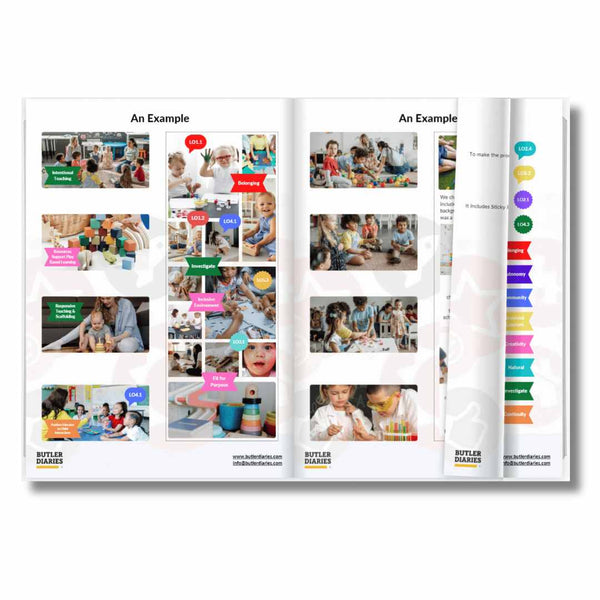
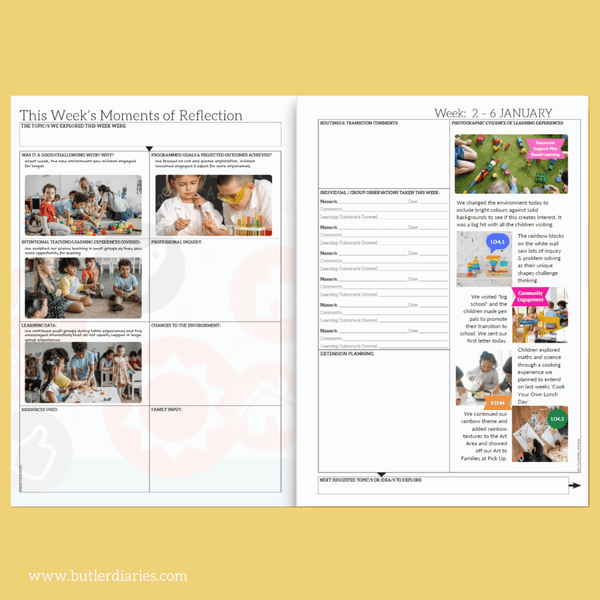
Daily reflections are a cornerstone of flexible programming. At the end of each day, evaluate which planned activities were successful and identify spontaneous moments worth expanding into next week’s program. Tools like the Butler Diaries' Weekly Programming and Reflection Child Educator Diary include extension columns to capture these insights in one place. The diary also features EYLF outcome coding stickers, making it easier to manage compliance while staying adaptable. It’s no surprise that it has earned a 4.9/5 star rating from 63 reviews.

When documenting group activities, sticky notes or mini-reflections can highlight how individual children respond differently to the same experience. This method ensures diverse needs are met without creating separate schedules for each child. Linking spontaneous activities to specific EYLF outcomes - such as noting that a beetle discovery supports Outcome 2 (Children are connected with and contribute to their world) and Outcome 4 (Children are confident and involved learners) - keeps your programming aligned with educational objectives.
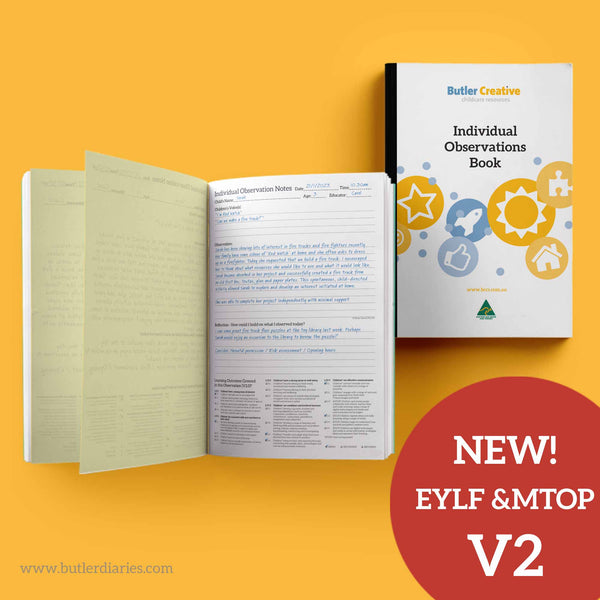
For more detailed observations, the Individual Observations Duplicate Book offers a handy, portable solution. Combined with daily jottings, it helps create a well-rounded view of children’s interests and developmental needs, ensuring tomorrow’s schedule reflects their evolving curiosities and goals.
sbb-itb-706bda8
Linking EYLF Outcomes to Daily Routines
Every moment within a childcare service, from morning arrivals to tidying up, contributes to children's learning. The EYLF describes curriculum as "all the interactions, experiences, activities, routines and events, planned and unplanned, that occur in an environment designed to foster children's learning and development". This means even the simplest daily routines are purposeful learning opportunities, thoughtfully tied to specific outcomes in your curriculum plan.
Mapping EYLF Outcomes to Routine Activities
The "This is evident when" sections in EYLF Framework V2.0 offer clear behavioural indicators to help you link routine activities to specific outcomes. For instance, when children engage in familiar arrival rituals - like hanging up their bag or greeting educators - they’re demonstrating Outcome 1.1 (Children feel safe, secure, and supported). Similarly, recognising patterns during transitions, such as knowing outdoor play follows morning tea, reflects Outcome 5.4 (Children notice and predict patterns of regular routines and the passing of time).
To make these connections more visual, consider using icons, colours, or codes to indicate whether activities are guided by family input, child interest, or educator planning. For example, during meal times, you might observe children recognising when they’re hungry or thirsty (Outcome 3.3) or gaining independence in hygiene routines. Even tidying up can align with Outcome 2.4 when you integrate principles like reducing, reusing, and recycling into daily practices.

Here’s a quick look at how routine activities can align with EYLF outcomes:
| Routine Activity | Linked EYLF Outcome | Evidence of Achievement |
|---|---|---|
| Arrival/Departure | Outcome 1.1 | Children participate in familiar rituals, showing belonging. |
| Transitions | Outcome 5.4 | Children notice and predict patterns in routines. |
| Meal Times | Outcome 3.3 | Children recognise and communicate hunger or thirst. |
| Personal Hygiene | Outcome 3.3 | Children develop independence in hygiene practices. |
| Group Play | Outcome 2.1 | Children cooperate and build relationships with peers. |
| Tidying Up | Outcome 2.4 | Children demonstrate respect and care for their environment. |
These links help you plan daily routines with intention, ensuring that every activity contributes to children’s development and aligns with EYLF outcomes.
To document these connections, use phrases like "Today, I observed [Child's Name] as a confident and involved learner". This approach not only captures evidence of learning but also ensures compliance with EYLF requirements. Incorporating family and community input further enriches these daily learning opportunities.
Including Family and Community Input
Incorporating family and community input into routine activities adds depth to children’s learning experiences. For instance, family contributions can enhance Outcome 2 by strengthening children’s connection to their world. Use drop-off and pick-up times to gather updates from families - whether it’s a recent house move, a new skill, or a cultural celebration - and weave these insights into your curriculum as "Parent Input". Learning a few words in a child’s home language for arrival and departure routines fosters belonging and supports Outcome 1.
"Getting parents involved not only in passing on key routines from home, but also sharing in key routines for your early childhood service, will strengthen the security and comfort children take from routines." – Natalie Higgins and David Gregory, Raise Learning

Encourage family participation in planned activities, such as storytelling or group play, to create meaningful connections between home and your service. For cultural events or festivals, collaborate with families ahead of time to ensure thoughtful engagement. Inviting Aboriginal and Torres Strait Islander Elders to share their knowledge enriches your curriculum and ensures respectful cultural practices.
Involving families in daily routines, like hygiene practices, also promotes consistency and strengthens children’s sense of security. Tools like the Butler Diaries Weekly Programming and Reflection Diary make it easier to track family input and community partnerships. Butler Diaries has found in their case studies, "The families and community enjoy looking at the diaries", highlighting how transparent documentation builds trust and demonstrates how routines support all five EYLF outcomes.
Planning Tools and Resources for Compliance
Keeping EYLF-aligned daily schedules on track can feel like a juggling act, but having the right tools makes all the difference. Butler Diaries provides a range of resources designed to simplify documentation while meeting the requirements of Regulations 73–76 and Quality Area 1 during Assessment and Rating. These tools integrate smoothly with existing programming strategies, helping educators maintain compliance without added stress.
Butler Diaries Products for EYLF Planning

The Weekly Programming and Reflection Diary is a go-to resource for room-based documentation. Its structured layouts support weekly programming and reflection, directly linking activities to EYLF (+ WAKLG, VEYLDF) outcomes and principles. It also includes sections for critical reflection, intentional teaching, family input, and transition planning - key areas assessors focus on when evaluating services. This EYLF Diary is also available in other versions, such as EYLF Outdoor Planning, FDC Combined Monthly Planning, and other Frameworks like MTOP and QKLG.
For staff communication, the Children's Centre Diary is an excellent option. Designed to promote communication and consistency of practice, this Diary works as a teams Diary between the whole service or office and leadership teams.
Leadership teams can also benefit from specialised diaries designed for goal tracking, self-assessment for A&R preparation, and team communication logs. These include Diaries like the Nominated Supervisor Diary and Educational Leader Diary that support role responsibilities and compliance records.
To make learning more visible to families, Special Interest Wall Calendars, such as Our Sustainable Year or Our Culturally Responsive Year, provide large-format visual documentation aligned with EYLF principles.

Butler Diaries also offers Digital Courses and Training starting at $9.99. These include guides for using their Diaries and the Cycle of Planning Professional Development course, which supports educators in mastering the cycle and EYLF v2.0 compliance. With over 35,000 satisfied customers and a 4.95-star rating, these resources are trusted by educators nationwide. As Craig Fenoglio, a Family Day Care educator, puts it:
"From the Family Daycare perspective, this diary is integral to compliance, planning, communications, and programming!"
Comparing Tools for Scheduling and Reflection
Different tools cater to specific needs within an EYLF-aligned planning system. Here's a breakdown of how Butler Diaries products support various aspects of daily scheduling and compliance:
| Tool Type | Primary Focus | Key Features | Best For |
|---|---|---|---|
| Weekly Programming Diary | Room-based curriculum | Framework checklist, reflection spreads, family input | Daily programming and planning documentation |
| Outdoor Programming Diary | Outdoor curriculum, 1 per space | Framework checklist, open reflection, safety checks | Daily programming and planning documentation |
| Leadership Diaries | Compliance and management | Goal tracking, A&R self-assessment, team logs | Educational Leaders and Supervisors |
| Wall Calendars | Visual learning documentation | Themed prompts (Sustainability/Culture), large format | Highlighting learning for families |
| Individual Observation Book | Assessment for Learning | Duplicate pages, outcome linking fields | Portfolio maintenance and Practice 7 tasks |
| Children's Voices Diary | Children's input | Reflective prompts for children | Embedding children's voices |
These tools create a unified system for managing compliance and supporting EYLF outcomes across daily routines. Everything is consolidated in one place, eliminating the clutter of multiple folders and loose papers. For added convenience, the Programming and Reflection Printer Pack allows educators to include photo evidence, illustrating how daily routines meet all five EYLF outcomes.

Key Takeaways for EYLF-Aligned Scheduling
Creating daily schedules that align with EYLF principles goes beyond ticking compliance boxes - it’s about building a framework that nurtures children’s learning while lightening the documentation load. Under Quality Area 1 of the National Quality Standard, educational programmes must respond to children’s interests through an ongoing cycle of planning and evaluation. The challenge lies in balancing structure with flexibility, ensuring routines provide predictability for children while adapting to their evolving interests and needs.
The right tools can make this balance easier to achieve. Butler Diaries offers resources that simplify documentation across multiple NQS Quality Areas. For instance, their Weekly Programming and Reflection Diary supports QA1 and QA5 by documenting planning cycles and relationships with children. Meanwhile, their NCR Books - used for recording medication, injuries, and other key details - help meet QA2 and QA7 requirements by ensuring proper record-keeping. This integrated approach allows educators to focus more on the children and less on administrative tasks.
Schedules that combine structure and flexibility provide children with the security of consistent routines while giving educators the freedom to seize teachable moments. When documentation becomes a tool for reflection rather than a chore, it enhances both teaching and learning experiences. Purpose-built resources can significantly reduce stress and lead to better outcomes for everyone involved.
The most effective EYLF-aligned schedules are dynamic tools that grow and adapt with your group’s needs. They incorporate family input, reflect cultural diversity, and make learning visible to all stakeholders. By utilising resources specifically designed for Australian early childhood settings, you’re not just meeting regulatory requirements - you’re creating an environment where children can flourish and educators feel supported.
FAQs
How can I include Aboriginal and Torres Strait Islander perspectives in my daily schedule?
Incorporating Aboriginal and Torres Strait Islander perspectives into daily routines is a meaningful way to promote cultural awareness and align with the principles of the EYLF. This can be done by naturally weaving cultural practices, stories, and traditions into everyday activities. For instance, you might include storytelling sessions featuring Dreaming stories, create art inspired by traditional Indigenous techniques, or explore music that reflects First Nations cultures. These activities help foster respect, a sense of belonging, and a deeper connection to the land.

Starting the day with an Acknowledgement of Country, or a Welcome to Country when appropriate, is another powerful practice. To ensure these gestures are authentic, it’s essential to consult with local Indigenous communities. Building relationships with families and community members can further enhance your understanding and allow you to represent their perspectives in a meaningful way. This approach helps create a culturally safe and inclusive learning environment.
Tools like Butler Diaries can assist in documenting and reflecting on how Indigenous perspectives are incorporated into your program. By using such resources, you can ensure your practices remain inclusive and responsive, enriching children’s learning experiences while supporting their identity and connection to Country.
How can families contribute to EYLF-aligned routines in early childhood settings?
Involving families in routines that align with the EYLF (Early Years Learning Framework) strengthens connections and enhances children’s learning experiences. Start by keeping communication lines open. Use regular updates, newsletters, or apps to ensure families are informed about their child’s progress and daily activities. Scheduling parent meetings can also provide valuable opportunities to discuss a child’s interests, strengths, and areas where support might be needed.
Collaboration is key. Gather feedback through surveys or invite families to join in on activities such as cultural celebrations or classroom visits. Sharing ideas and resources for learning at home, along with incorporating family traditions and practices, helps create routines that celebrate the diversity of children’s backgrounds. These approaches align closely with EYLF principles, building a respectful and cooperative environment for both children and their families.
How can I create flexible daily schedules that still align with EYLF outcomes?
To create flexible daily schedules that align with EYLF outcomes, it's essential to adopt a child-focused and adaptable approach. This involves paying close attention to children’s interests, strengths, and needs as they unfold throughout the day. By doing so, educators can adjust activities and routines to support each child’s development. The EYLF places a strong emphasis on flexibility and the ability to make spontaneous decisions, ensuring learning experiences remain meaningful and engaging.
Using a reflective planning cycle - such as observing, assessing, and evaluating - can help educators fine-tune schedules while staying aligned with learning objectives. Tools like personalised planners or diaries can assist in balancing structured routines with moments of spontaneity, keeping things organised while meeting compliance requirements. Open communication with children and their families is also crucial. This ensures schedules are collaborative and effective, staying true to the core principles of the EYLF.
Related Articles