
WA Kindergarten Curriculum Guidelines: Learning Outcomes Explained for Western Australian Educators
Understand the Western Australian Kindergarten Curriculum Guidelines, including all five learning outcomes, their focus areas and connections to EYLF V2.0. Explore practical examples for programming, assessment, documentation and critical reflection, with guidance for applying the framework in everyday Kindergarten practice.

A complete guide to the Western Australian Kindergarten Curriculum Guidelines, the five learning outcomes, their focus areas, and practical ways to apply them through programming, assessment and reflection.
The Western Australian Kindergarten Curriculum Guidelines provide a foundation for planning meaningful learning experiences that respond to children's strengths, interests, cultures, capabilities and development.
Developed by the School Curriculum and Standards Authority (SCSA), the Guidelines draw on the Early Years Learning Framework V2.0 (EYLF V2.0) and explain its learning outcomes in the context of Western Australian Kindergarten.
For educators, understanding the WA Kindergarten learning outcomes means more than knowing their names. It involves recognising how learning develops through play, relationships, inquiry, intentional teaching and everyday experiences, then using that understanding to inform curriculum decisions.
This guide explores the five learning outcomes, their focus areas, the relationship between the Guidelines and EYLF V2.0, and how educators can use them to support programming, assessment and critical reflection.
What are the Western Australian Kindergarten Curriculum Guidelines?
The Kindergarten Curriculum Guidelines (KCG) are published by the Western Australian School Curriculum and Standards Authority.
They support educators to develop curriculum for children attending Kindergarten in Western Australia.
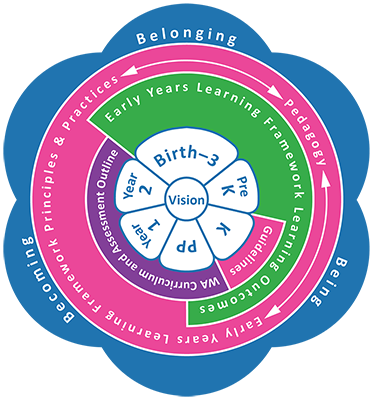
The Guidelines form part of the Western Australian Curriculum and Assessment Outline and provide a bridge between the national Early Years Learning Framework and the Western Australian Kindergarten context.
The current official document is copyright 2025 and incorporates the EYLF V2.0 Vision, Principles and Practices.
The Guidelines are designed to support educators to:
-
Develop responsive, inclusive Kindergarten programs.
-
Recognise children's existing knowledge, capabilities, cultures and experiences.
-
Support learning through play-based experiences and intentional teaching.
-
Assess children's learning, development and wellbeing.
-
Work in partnership with children, families and communities.
-
Support continuity of learning and transitions into Pre-primary.
Official source: SCSA Kindergarten Curriculum Guidelines
How do the WA Kindergarten Curriculum Guidelines relate to EYLF V2.0?
The WA Kindergarten Curriculum Guidelines are not a replacement for the Early Years Learning Framework.
Instead, they explain how the EYLF's Vision, Principles, Practices and Learning Outcomes apply to the Kindergarten year in Western Australia.
The Guidelines retain the five broad EYLF outcomes while using some WA-specific outcome titles and providing detailed content relevant to kindergarten-aged children.
| EYLF V2.0 learning outcome | WA Kindergarten learning outcome |
|---|---|
| Outcome 1: Children have a strong sense of identity | Identity |
| Outcome 2: Children are connected with and contribute to their world | Connecting and Contributing |
| Outcome 3: Children have a strong sense of wellbeing | Wellbeing |
| Outcome 4: Children are confident and involved learners | Learning and Thinking |
| Outcome 5: Children are effective communicators | Communication |
These outcomes are interconnected. Children's learning does not occur in separate categories, and one experience can provide evidence of learning across several outcomes.
The Guidelines also explain that children develop at different rates and enter Kindergarten with different experiences. The learning examples are intended to support educators' professional judgement, rather than establish identical expectations for every child.

What are the five WA Kindergarten learning outcomes?
The five outcomes are:
-
Identity
-
Connecting and Contributing
-
Wellbeing
-
Learning and Thinking
-
Communication
Each outcome contains broader learning areas, more detailed focus areas and examples of children's learning.
The following summaries explain the official structure in practical terms. For the complete descriptors and examples, educators should refer to the SCSA document.
Outcome 1: Identity
Related EYLF Outcome 1: Children have a strong sense of identity.
Identity focuses on children's developing understanding of who they are, their sense of belonging, their confidence and their relationships with others.
The Guidelines recognise that children's identities are influenced by their families, cultures, communities, experiences and interactions.
A positive sense of identity supports children to approach learning with confidence, develop relationships, make choices and recognise themselves as valued members of their communities.
Outcome 1 learning areas and focus areas
1. Feeling safe, secure, accepted and supported
This includes developing trusting relationships and a sense of belonging.
Educators may observe children building relationships with familiar adults, participating in play, expressing their needs and connecting experiences at Kindergarten with their home lives.
2. Acting with increasing autonomy, interdependence, resilience and agency
This includes developing resilience and attention, making decisions and managing everyday routines.
Children may demonstrate this learning when they persist with challenges, make choices, organise their belongings or negotiate decisions with others.
3. Building knowledgeable, confident self-identities and a positive sense of self-worth
This includes developing confidence in personal capabilities and positive connections with family, culture and community.
Educators can support this by recognising children's achievements, valuing their experiences and ensuring their cultures and identities are reflected in the learning environment.
4. Interacting in relation with others with care, empathy and respect
This includes positive participation in groups and responding to others appropriately.
Children may demonstrate developing empathy, cooperation, awareness of others' needs and respectful interactions.
Practical example: Supporting identity
A child who is new to Kindergarten may initially prefer to remain close to a familiar educator.
Over time, the educator observes the child beginning to join shared play, communicate preferences and initiate interactions with peers.
Rather than simply documenting participation, the educator considers what these changes reveal about the child's developing security, belonging and confidence.
The educator may respond by maintaining predictable routines, strengthening relationships and creating further opportunities for the child to make meaningful choices.
Reflection question: How do our relationships, routines and learning environments help every child feel that they belong?

Outcome 2: Connecting and Contributing
Related EYLF Outcome 2: Children are connected with and contribute to their world.
Connecting and Contributing explores children's relationships with communities, cultures, people, places and environments.
The Guidelines recognise that children are active participants in their communities and can contribute meaningfully to decisions affecting their lives.
Outcome 2 learning areas and focus areas
1. Developing connectedness to groups and communities and understanding rights and responsibilities
This includes developing collaboration, citizenship, inquiry and communication.
Children may participate in shared decision-making, work together to solve problems and explore their connections with families and communities.
2. Exploring diversity and responding with respect
This includes exploring cultural differences and similarities, broadening understanding and developing respectful responses to diversity.
Educators support children by ensuring different languages, cultures, experiences and perspectives are genuinely represented and valued.
3. Becoming aware of fairness
This includes recognising fairness and developing ways to respond when situations are unfair.
Children may begin to discuss equitable participation, recognise exclusion and consider how decisions affect others.
4. Showing social responsibility and respect for the environment
This includes exploring natural and constructed environments, understanding relationships between people and environments, and participating in environmental care.
Practical example: Investigating the local environment
Children notice changes in a garden after heavy rain.
They begin discussing where the water goes, why some plants look different and how the garden might be cared for.
Educators could support an ongoing investigation involving observation, conversations, drawing, family contributions and decisions about caring for the space.
This inquiry may connect with environmental responsibility, collaboration, communication and scientific thinking.
It may also create opportunities for meaningful engagement with local Aboriginal knowledge and connections to Country, developed respectfully with appropriate community involvement.
Reflection question: Are children genuinely contributing to decisions about their learning environment, or are they only participating in adult-directed activities?
Outcome 3: Wellbeing
Related EYLF Outcome 3: Children have a strong sense of wellbeing.
Wellbeing encompasses children's physical, social, emotional and mental wellbeing.
The Guidelines recognise the importance of supportive relationships, positive emotional experiences, movement, health, safety and children's developing ability to understand and respond to their needs.
Outcome 3 learning areas and focus areas
1. Becoming strong in social, emotional and mental wellbeing
This includes developing positive relationships, recognising emotions, expressing feelings and building self-regulation.
Children may demonstrate this learning through friendships, cooperation, communication about feelings and increasing use of strategies to respond to challenges.
2. Taking increasing responsibility for health and mental and physical wellbeing
This includes building movement capabilities, physical coordination, confidence and positive attitudes towards physical activity.
Learning may be evident through outdoor play, dance, movement, balancing, manipulating materials and participation in physical experiences.
3. Developing strategies to support mental and physical health and personal safety
This includes exploring health and safety practices and developing approaches that support positive mental wellbeing.
Educators can support children to recognise their needs, seek assistance, understand safety and develop appropriate strategies for wellbeing.
Practical example: Developing confidence through movement
Children begin creating their own obstacle courses using outdoor equipment.
Some experiment with balancing, while others explore jumping, climbing or moving through spaces.
The educator observes children's developing coordination, confidence, decision-making and responses to physical challenges.
These observations inform decisions about additional resources, appropriate challenges, inclusive participation and opportunities to revisit developing skills.
Reflection question: How do we provide appropriate challenge while ensuring children feel physically and emotionally safe?

Outcome 4: Learning and Thinking
Related EYLF Outcome 4: Children are confident and involved learners.
Learning and Thinking focuses on children's curiosity, investigation, problem-solving, creativity, persistence and development of mathematical and scientific understandings.
The Guidelines recognise children as capable learners who actively construct knowledge through relationships, play, experimentation and intentional teaching.
Outcome 4 learning areas and focus areas
1. Developing a growth mindset and positive dispositions for learning
This includes confidence, cooperation, persistence, curiosity, enthusiasm, resourcefulness and reflection.
Children may demonstrate this learning when they persist with a difficult task, experiment with alternatives or return to an investigation.
2. Developing skills and processes for learning and thinking
This includes problem-solving, inquiry, investigation, reflecting on learning, applying knowledge in different situations and organising themselves for learning.
Educators may observe children making predictions, testing ideas, discussing strategies and transferring previous knowledge into new experiences.
3. Engaging in creative and inventive ways of thinking and doing
This includes experimentation, imagination, innovation and representing ideas through creative experiences.
Children may explore construction, dramatic play, art, music, movement and different ways of expressing their thinking.
4. Engaging in and extending numeracy in personally and culturally meaningful ways
This includes early understandings of number and algebra, measurement and geometry, and statistics and probability.
The Guidelines identify learning associated with counting, quantities, patterns, measurement, shapes, spatial relationships, collecting information and considering possibilities.
These concepts can be explored through play, investigations, routines and meaningful everyday experiences.
Practical example: An ongoing construction inquiry
A group of children begin building bridges using blocks and recycled materials.
Initially, they experiment with how to make the bridge stand.
As the investigation continues, children compare materials, test different arrangements, measure distances and discuss why some structures are more stable than others.
The educator documents children's predictions, problem-solving strategies and developing understanding.
Rather than replacing the experience with an unrelated activity the following week, the educator uses the observations to introduce new materials and opportunities for further investigation.
Reflection question: Are children given sufficient time to test, revisit and develop their ideas, or do our programming decisions interrupt deeper learning?
Outcome 5: Communication
Related EYLF Outcome 5: Children are effective communicators.
Communication encompasses the many ways children express themselves, interpret information, interact with others and make meaning.
The Guidelines recognise communication through speech, gestures, signs, movement, creative expression, symbols, written language and digital technologies.
They also emphasise the importance of valuing children's home languages, dialects and cultural communication practices.
Outcome 5 learning areas and focus areas
1. Interacting verbally and non-verbally for different purposes
This includes oral language, listening, phonological awareness and constructing messages.
Children may demonstrate this through conversations, storytelling, questions, gestures, rhymes, sound exploration and communication during play.
2. Engaging in and extending literacy practices
This includes developing understanding of different texts and exploring reading, writing and viewing behaviours.
Educators may observe children engaging with books, recognising familiar print, experimenting with mark-making and using symbols to communicate ideas.
3. Understanding symbols and pattern systems
This includes developing concepts of print and investigating symbols and patterns.
Children may explore letters, signs, numbers, familiar symbols and the ways representations communicate meaning.
4. Expressing ideas and making meaning through media and materials
This includes creating with different materials and investigating their properties.
Children may communicate through drawing, painting, sculpture, music, movement, drama and other creative experiences.
5. Using digital technologies and media
This includes exploring tools and technologies in play and developing simple digital skills.
The Guidelines recognise opportunities for children to use appropriate technologies to investigate ideas, access information and represent their thinking.
Practical example: Communication through dramatic play
Children create a pretend shop.
They begin making signs, drawing shopping lists, exchanging ideas, using numbers and negotiating roles.
An educator observes the different ways children communicate and supports their emerging interests by introducing relevant texts, materials and opportunities for conversation.
This experience may connect with oral language, early literacy, numeracy, social interaction and creative expression.
Reflection question: Are we recognising all the ways children communicate, including non-verbal communication, home languages and creative expression?
The EYLF Principles and Practices within the WA Kindergarten Curriculum Guidelines
The Guidelines incorporate the eight EYLF V2.0 Principles and eight Practices.
These guide the decisions educators make about relationships, environments, teaching, assessment and curriculum.
The eight EYLF Principles
-
Secure, respectful and reciprocal relationships
-
Partnerships
-
Respect for diversity
-
Aboriginal and Torres Strait Islander perspectives
-
Equity, inclusion and high expectations
-
Sustainability
-
Critical reflection and ongoing professional learning
-
Collaborative leadership and teamwork
The eight EYLF Practices
-
Holistic, integrated and interconnected approaches
-
Responsiveness to children
-
Play-based learning and intentionality
-
Learning environments
-
Cultural responsiveness
-
Continuity of learning and transitions
-
Assessment and evaluation for learning, development and wellbeing
-
Collaborative leadership and teamwork
These Principles and Practices help educators consider not only what children are learning, but how professional decisions and learning environments support that learning.
For example, recognising children's interest in insects may connect with Learning and Thinking. How educators respond through inquiry, intentional teaching, cultural responsiveness and assessment reflects the Practices.
Planning and assessment using the WA Kindergarten Curriculum Guidelines
The Guidelines explain that curriculum decision-making involves considering children's existing knowledge, interests, capabilities, contexts and learning needs.
They identify important considerations including differentiation and inclusion, learning environments, relationships, balanced content, child participation and opportunities for engagement and extension.
Educators can use the Guidelines to inform an ongoing process of observation, assessment, planning, implementation and evaluation.
A practical approach to documenting learning
Observe: What are children doing, saying, investigating or communicating?
Analyse: What does the evidence suggest about their learning and development?
Connect: Which learning outcomes and focus areas help explain the learning?
Plan: How can educators respond through intentional teaching, resources, environments and interactions?
Reflect: What happened, what did children demonstrate and what should happen next?
These are suggested documentation prompts, not a replacement for the curriculum decision-making processes explained in the official Guidelines.
Do all five outcomes need to be documented every week?
The Guidelines identify five interconnected outcomes, but they do not establish a requirement to document evidence of all five outcomes in every individual week.
Educators should make meaningful connections based on children's actual learning rather than attempting to attach every outcome to every experience.
An ongoing investigation may provide evidence connected to several outcomes over time.
The important consideration is whether educators are using their knowledge of children and the Guidelines to make informed curriculum decisions.

How the WA Kindergarten Curriculum Guidelines connect with the National Quality Standard
The Guidelines include an appendix linking their Principles, Practices and Learning Outcomes with the National Quality Standard (NQS).
For education and care services operating under the National Quality Framework, these connections are particularly relevant to Quality Area 1: Educational program and practice.
Key elements include:
Element 1.1.1 – Approved learning framework: Curriculum decision-making contributes to each child's learning and development outcomes.
Element 1.1.2 – Child-centred: The program is informed by children's current knowledge, strengths, ideas, culture, abilities and interests.
Element 1.2.1 – Intentional teaching: Educators make deliberate, purposeful and thoughtful decisions.
Element 1.3.1 – Assessment and planning cycle: Assessment and planning are ongoing and inform educational programming.
Element 1.3.2 – Critical reflection: Critical reflection informs program planning and implementation.
The Guidelines also connect with other quality areas, including relationships with children, collaborative partnerships with families, inclusion and the physical environment.

Using the 2027 Weekly Programming and Reflection Diary with the WA Kindergarten Curriculum Guidelines
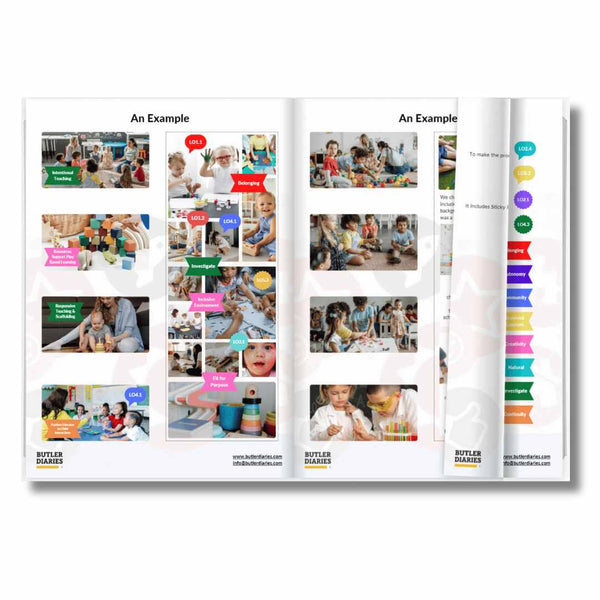
The 2027 Weekly Programming and Reflection Diary includes references to the Western Australian Kindergarten Curriculum Guidelines.
It provides a practical way for educators to bring framework knowledge into their everyday programming and reflection.
Rather than treating the Guidelines as a document to consult only when writing a program, educators can use them to consider the learning evident in their observations and how that learning informs future decisions.
Linking observations with learning outcomes
Educators can identify relevant WA Kindergarten learning outcomes when documenting children's experiences.
For example, an observation of children experimenting with construction materials might connect with Learning and Thinking, while the negotiation and collaboration taking place may also connect with Connecting and Contributing.
The aim is to identify meaningful learning rather than attach as many outcomes as possible.
Supporting an ongoing planning cycle
The Diary's weekly programming and reflection structure provides regular opportunities to review children's learning and consider future directions.
A weekly spread does not mean an investigation needs to finish at the end of the week.
An inquiry can continue across several weeks, with each reflection informing what happens next.
Documenting evidence of learning
The 2027 Diary's Evidence of Learning section supports educators to consider different forms of documentation.
Depending on the learning, this may include children's words, observations, drawings, explanations, investigations or other evidence.
For example, a child's explanation of why a bridge collapsed may reveal more about their thinking than a photograph of the completed construction.
Strengthening critical reflection
Educators can use their reflection time to consider:
-
What did the children demonstrate about their learning?
-
Which outcomes and focus areas were most relevant?
-
How did our intentional teaching support or extend their ideas?
-
Were our environments and experiences inclusive?
-
What did we learn about the effectiveness of our approach?
-
What should we continue, change or investigate further?
Using the Diary alongside the Guidelines can help educators make the relationship between observation, planning, teaching and reflection more visible.

Frequently asked questions about the WA Kindergarten Curriculum Guidelines
What are the WA Kindergarten Curriculum Guidelines?
They are guidelines published by the School Curriculum and Standards Authority to support curriculum planning and learning in Western Australian Kindergarten.
How many WA Kindergarten learning outcomes are there?
There are five: Identity, Connecting and Contributing, Wellbeing, Learning and Thinking, and Communication.
Are the WA Kindergarten Curriculum Guidelines the same as EYLF V2.0?
No. The Guidelines incorporate the EYLF Vision, Principles and Practices and explain its learning outcomes for the Western Australian Kindergarten context.
Are the Guidelines different from the Western Australian Curriculum?
Yes. The Kindergarten Curriculum Guidelines support curriculum planning for the Kindergarten year, while the Western Australian Curriculum provides learning area content for compulsory schooling from Pre-primary onwards.
The Guidelines also include connections to the Pre-primary curriculum to support continuity of learning.
Do the Guidelines include literacy and numeracy?
Yes. Literacy is addressed particularly through Communication, while numeracy is explicitly included in Learning and Thinking. Both are also relevant across everyday experiences and other learning outcomes.
Do children need to achieve every learning outcome before Pre-primary?
The Guidelines recognise that children develop at different rates and have diverse experiences. They are intended to guide responsive teaching and learning rather than impose identical developmental expectations on every child.
How do educators use the Guidelines for assessment?
Educators can use the outcomes and focus areas to interpret observations, identify learning, inform curriculum decisions and consider how to support children's continued development.
Which Butler Diaries diary includes the WA Kindergarten Curriculum Guidelines?
The 2027 Weekly Programming and Reflection Diary includes WA Kindergarten Curriculum Guidelines references and supports ongoing programming and reflection.
Bringing the WA Kindergarten Curriculum Guidelines into everyday practice
The Western Australian Kindergarten Curriculum Guidelines provide educators with a detailed resource for understanding children's learning and making informed curriculum decisions.
Their five learning outcomes recognise the interconnected nature of children's development, while the Principles and Practices support educators to create responsive, inclusive and meaningful learning environments.
Effective programming is not about completing a checklist of outcomes. It is about understanding the learning taking place, responding intentionally and using assessment and reflection to guide what happens next.
By using the Guidelines alongside a consistent programming and reflection system, educators can make children's learning more visible while keeping their interests, strengths, identities and capabilities at the centre of curriculum decisions.
Official resources and further reading
School Curriculum and Standards Authority
- Kindergarten Curriculum Guidelines – Official SCSA resource page
- Download the Kindergarten Curriculum Guidelines – Official PDF
- Western Australian Curriculum and Assessment Outline
- Early Childhood Teaching and Learning Videos – SCSA
Related Butler Diaries resource
Related Articles