
VEYLDF Learning Outcomes Explained: A Guide to the Updated 2026 Victorian Early Years Learning and Development Framework
Understand the updated 2026 Victorian Early Years Learning and Development Framework (VEYLDF), including its five learning outcomes, Practice Principles and Learning and Development Maps. Explore practical examples and ways to connect the framework with everyday programming, observations and critical reflection.

The Victorian Early Years Learning and Development Framework (VEYLDF) guides how early childhood professionals support children's learning, development and wellbeing from birth to eight years.
Updated in 2026, the VEYLDF continues to provide a shared foundation for planning, assessment, reflective practice and collaboration between educators, families and other professionals.
For Victorian educators, understanding the VEYLDF learning outcomes is an important part of developing meaningful, child-centred educational programs. However, applying the framework involves more than identifying which learning outcome an experience relates to. It means understanding children's learning, recognising their strengths and interests, making informed teaching decisions and using observations and reflection to guide what happens next.
This guide explores the updated VEYLDF, its five learning and development outcomes, the Practice Principles, the Early Years Planning Cycle and practical ways educators can use the framework in their everyday programming and documentation.
What is the Victorian Early Years Learning and Development Framework (VEYLDF)?
The Victorian Early Years Learning and Development Framework is Victoria's framework for supporting the learning and development of children from birth to eight years.
Originally introduced in 2009, revised in 2016 and updated in 2026, the framework provides guidance for professionals working across early childhood education, health, family support and the early years of school.
The VEYLDF recognises that children's learning and development are interconnected. Their relationships, wellbeing, identities, communication, experiences and opportunities to participate all contribute to their learning.
It also recognises the importance of partnerships between professionals and families, continuity of learning and positive transitions between settings.
The VEYLDF is an approved learning framework for Victorian education and care services under the Education and Care Services National Law. Providers delivering funded kindergarten programs in Victoria are required to use the VEYLDF to develop and implement their educational programs.
Official framework: Victorian Early Years Learning and Development Framework – Victorian Government
What changed in the 2026 VEYLDF update?
The Victorian Government updated the VEYLDF in 2026 to reflect contemporary evidence and strengthen guidance for early childhood professionals.
The changes include:
-
Updated learning and development outcome descriptors: Revised to align with the Early Years Learning Framework V2.0 and Victorian Curriculum F–10 Version 2.0.
-
Stronger attention to child safety and wellbeing: Reinforcing their importance throughout professional practice.
-
Integrated teaching and learning approaches: Now positioned alongside the Early Years Planning Cycle, rather than within the Practice Principles.
-
Clearer guidance on intentional teaching: Supporting educators to understand how deliberate teaching decisions contribute to children's learning.
-
Additional cultural knowledge stories: Supporting professionals to deepen their understanding of cultural knowledge and perspectives.
-
More practical examples: Helping professionals recognise what applying the Practice Principles can look like in everyday practice.
-
Learning and Development Maps: Supporting understanding of how learning across the VEYLDF outcomes connects with the first three years of school.
When do Victorian services need to implement the updated VEYLDF?
The Victorian Government has introduced a phased approach.
Throughout 2027, kindergartens can align their programs with the updated framework. From January 2028, the Victorian Early Childhood Regulatory Authority will engage with the updated VEYLDF during Assessment and Rating visits.
This transition provides an opportunity for services to familiarise themselves with the changes, review their existing programming and documentation practices, and discuss how the updated guidance can strengthen their work.
Rather than treating the update as a reason to start documentation systems from scratch, educators can examine how their current practices already support the framework and identify where adjustments would be beneficial.

What are the five VEYLDF learning and development outcomes?
The updated VEYLDF identifies five interconnected learning and development outcomes:
-
Identity
-
Connection
-
Wellbeing
-
Learning
-
Communication
These outcomes provide a shared way of understanding children's learning and development from birth to eight years.
They are interconnected rather than isolated areas of development. A single experience may contribute to several outcomes simultaneously.
For example, when children collaborate to build a structure using loose parts, they may be developing relationships and a sense of belonging, communicating ideas, negotiating decisions, experimenting with materials and building confidence in their abilities.
Educators can use the outcomes to recognise the learning taking place, understand its significance and make informed decisions about how to support children's continued development.
VEYLDF Outcome 1: Identity
Children have a strong sense of identity.
Identity is connected to how children understand themselves, develop confidence, experience belonging and recognise their place within relationships, families, cultures and communities.
Children's identities develop through their interactions and experiences with others. Secure, respectful relationships and environments that recognise children's individuality help create opportunities for them to express themselves, participate and develop a positive sense of self.
What might learning connected to identity look like?
Educators may observe children:
-
Expressing their preferences, interests and ideas.
-
Seeking support and reassurance from trusted adults.
-
Showing increasing confidence when participating in familiar or new experiences.
-
Recognising themselves as valued members of a group.
-
Sharing aspects of their family, language, culture or experiences.
-
Making choices and taking increasing responsibility in everyday routines.
These are illustrative examples for educators, not an official developmental checklist.
Supporting identity through programming
Consider a child who has recently started attending a service and is developing relationships with educators and other children.
Rather than focusing only on whether the child participates in group experiences, educators might observe how the child seeks reassurance, approaches familiar people, expresses preferences and begins to engage with the environment.
Their observations can inform decisions about consistent relationships, familiar routines, opportunities for choice and communication with the child's family.
Reflection prompt: How do our relationships, environments and everyday decisions communicate to each child that they belong and are valued?

VEYLDF Outcome 2: Connection
Children are connected with and contribute to their world.
Connection involves children's relationships with people, communities, cultures and environments, and their developing understanding of participation and contribution.
Children learn about their world through everyday experiences, relationships and opportunities to participate in meaningful decisions.
What might learning connected to connection look like?
Educators may observe children:
-
Developing relationships with peers and other members of their community.
-
Participating in shared decisions and collaborative experiences.
-
Expressing ideas about fairness, inclusion and belonging.
-
Showing curiosity about different people, places and ways of living.
-
Demonstrating care for living things and the environment.
-
Contributing to projects and experiences that matter to their group or community.
Supporting connection through programming
Imagine children notice rubbish collecting near an outdoor garden.
Their questions might lead to discussions about where rubbish comes from, how it affects living things and what the group could do.
Educators might support children to investigate, gather information, share their ideas and participate in decisions about caring for their environment.
The learning could continue across several weeks as children revisit their ideas, observe changes and consider new questions.
Reflection prompt: Are children genuinely involved in decisions about their environment and community, or are they primarily participating in decisions already made by adults?
VEYLDF Outcome 3: Wellbeing
Children have a strong sense of wellbeing.
Wellbeing encompasses children's physical, social and emotional experiences and their opportunities to feel safe, supported and capable.
Children's wellbeing is influenced by their relationships, environments, individual circumstances and experiences.
Supporting wellbeing involves responding to individual needs, providing safe and inclusive environments and recognising that children develop confidence and capabilities in different ways.
What might learning connected to wellbeing look like?
Educators may observe children:
-
Communicating physical or emotional needs.
-
Seeking comfort or support when needed.
-
Developing strategies for responding to emotions and challenges.
-
Exploring movement and physical capabilities.
-
Participating in routines that support health and wellbeing.
-
Demonstrating growing confidence in navigating familiar environments.
Supporting wellbeing through programming
Consider a group of children who have become interested in creating obstacle courses outdoors.
Educators might observe how children approach physical challenges, assess their capabilities, communicate when they need assistance and adapt their movements.
These observations could inform adjustments to the environment, opportunities for different levels of challenge and conversations that help children recognise their own capabilities.
Reflection prompt: How do we ensure our expectations and environments respond to individual children's wellbeing rather than expecting every child to participate in the same way?
VEYLDF Outcome 4: Learning
Children are confident and involved learners.
Learning involves children's curiosity, engagement, exploration, thinking, creativity and capacity to investigate ideas.
The VEYLDF recognises the importance of play and integrated teaching and learning approaches in supporting children's development.
Educators can support learning by recognising children's interests, providing opportunities for investigation, engaging in meaningful interactions and intentionally extending emerging ideas.
What might learning connected to this outcome look like?
Educators may observe children:
-
Investigating materials and testing ideas.
-
Asking questions and seeking explanations.
-
Persisting when experiences become challenging.
-
Revisiting previous discoveries.
-
Developing and adapting strategies.
-
Using imagination and creativity to explore possibilities.
-
Sharing ideas and learning with others.
Supporting learning through programming
Imagine children discover that some objects float while others sink.
Their initial curiosity might lead to predictions, investigations, comparisons and discussions.
Rather than ending the experience after one activity, educators could document children's theories and introduce new materials or questions that encourage further investigation.
Children might return to the experience over several days or weeks, developing and revising their ideas.
This is an example of how an ongoing inquiry can support learning while remaining responsive to children's interests.
Reflection prompt: Are we giving children opportunities to revisit, test and extend their thinking, or are experiences regularly replaced before deeper learning can develop?
VEYLDF Outcome 5: Communication
Children are effective communicators.
Communication involves the many ways children express themselves, connect with others, interpret information and make meaning.
Children communicate through spoken and signed languages, gestures, movement, creative expression, symbols, images and other forms of communication.
Educators can support communication by recognising children's individual ways of expressing themselves and creating environments where different languages, perspectives and communication approaches are respected.
What might learning connected to communication look like?
Educators may observe children:
-
Expressing ideas, needs and preferences in different ways.
-
Engaging in conversations and shared storytelling.
-
Using gestures, images, symbols or other communication methods.
-
Exploring books, signs, marks and written language.
-
Communicating through art, movement, music and dramatic play.
-
Using mathematical language and representations during everyday experiences.
-
Listening and responding to the ideas of others.
Supporting communication through programming
Consider children who are creating a pretend café.
They might develop menus, use symbols to represent prices, negotiate roles, exchange ideas and communicate orders.
Educators can observe the different forms of communication children use and introduce additional resources or interactions to support emerging interests.
The experience may connect with language, literacy, numeracy, social interaction and creative expression.
Reflection prompt: Whose voices and forms of communication are most visible in our documentation, and whose contributions might we be overlooking?

The seven VEYLDF Practice Principles
The updated VEYLDF identifies seven interconnected Practice Principles that guide how professionals work with children, families and one another.
These are:
-
Reflective practice
-
Partnerships with families
-
High expectations for every child
-
Respectful relationships and responsive engagement
-
Equity, diversity and inclusion
-
Assessment for learning and development
-
Partnerships between professionals
The Practice Principles are not additional learning outcomes for children. They guide the professional approaches used to support children's learning, development and wellbeing.
For example, recognising a child's interest in construction might connect with the Learning outcome. How an educator responds to that interest — through respectful engagement, assessment, family partnerships and reflection — relates to the Practice Principles.
In the updated framework, integrated teaching and learning approaches are positioned alongside the Early Years Planning Cycle, separate from the seven Practice Principles.
This distinction is important when reviewing older VEYLDF resources, which may present a different structure.
Understanding the VEYLDF Learning and Development Maps
A significant addition to the updated framework is the inclusion of Learning and Development Maps.
The maps support professionals to understand how learning and development connected to the VEYLDF outcomes continues into the first three years of school.
They can support educators and other professionals to:
-
Recognise children's learning and development over time.
-
Inform observations and planning.
-
Reflect on children's progress.
-
Support conversations with families and other professionals.
-
Consider how learning can be supported during transitions.
The maps are particularly relevant to continuity of learning between early childhood settings and school.
They should be used to deepen professional understanding of children's learning, rather than reduce children's experiences to a series of isolated achievements.
Educators should consult the maps within the official updated VEYLDF to understand their structure and intended use.

How does the VEYLDF relate to EYLF V2.0?
The Victorian Early Years Learning and Development Framework and the nationally approved Early Years Learning Framework V2.0 share a focus on children's learning, development, wellbeing and meaningful participation.
The 2026 VEYLDF update specifically aligns its revised outcome descriptors with EYLF V2.0 and the Victorian Curriculum F–10 Version 2.0.
Both frameworks recognise five broad areas of learning and development relating to identity, connection, wellbeing, learning and communication.
However, educators should not assume that every descriptor, practice or supporting resource is worded identically across the frameworks.
The VEYLDF provides Victorian-specific guidance across birth to eight years, including continuity between early childhood education and the early years of school.
When documenting learning, educators should refer to the framework applicable to their setting and use the relevant official descriptors rather than assuming the wording is interchangeable.

Applying the VEYLDF through the Early Years Planning Cycle
Understanding the learning outcomes is only one part of applying the framework.
Educators also need to consider how observations, assessment, planning, teaching and reflection inform one another.
The Victorian Government identifies the Early Years Planning Cycle as a central part of professional practice.
A practical way to approach this is to consider the following questions:
What are we noticing?
Observe children's interests, interactions, strengths, questions and developing capabilities.
What does this tell us about their learning?
Consider the significance of what has been observed, drawing on professional knowledge and relevant VEYLDF outcomes.
How might we respond?
Plan intentional teaching approaches, environments, resources and interactions that respond to children's learning.
What happened when we responded?
Gather evidence of children's participation, thinking, communication and developing understanding.
What have we learned, and what comes next?
Reflect on the effectiveness of the approach and consider whether to continue, extend, adapt or reconsider the learning opportunities.
These questions are practical prompts for educators, not a replacement for the official Early Years Planning Cycle.
Does a VEYLDF planning cycle need to finish every week?
No fixed weekly endpoint is established by the five VEYLDF outcomes.
An investigation might begin during one week and continue across several more as children develop new questions and interests.
For example, an inquiry into growing plants might involve observing seeds, investigating soil and water, documenting changes, discussing living things and considering ways to care for the environment.
The inquiry may connect with several learning outcomes and continue for as long as it remains meaningful.
A weekly programming format can provide a regular opportunity to document progress and reflect on what comes next without requiring educators to end an ongoing inquiry at the conclusion of each week.
Using the Weekly Programming and Reflection Diary with the VEYLDF
The Weekly Programming and Reflection Diary includes VEYLDF references alongside EYLF V2.0 and the Western Australian Kindergarten Curriculum Guidelines.
It is designed to help educators bring programming, observations, evidence of learning and critical reflection together within a consistent documentation system.
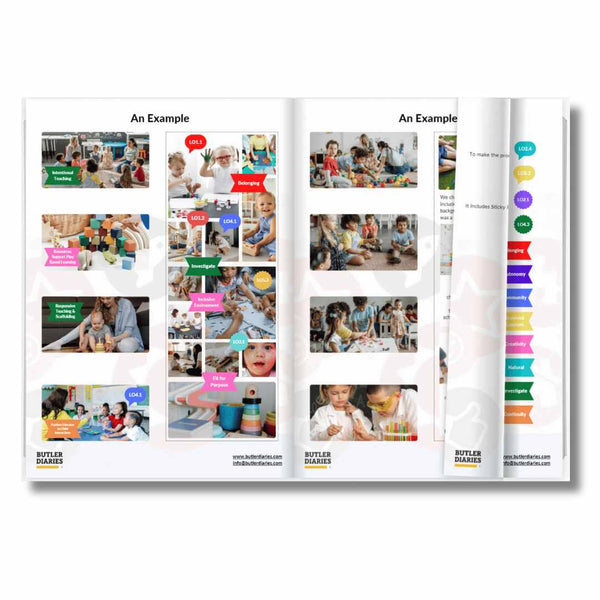
The Diary includes weekly programming and reflection spreads, with space for individual or group observation notes and evidence of learning.

Connecting learning to the VEYLDF
When documenting an observation or planned experience, educators can consider which VEYLDF outcome or outcomes are relevant.
The intention is not to assign as many outcomes as possible to every experience. Instead, identify the connections that genuinely help explain the learning taking place.
Making the planning cycle visible
The Diary's regular programming and reflection structure can help educators show how observations inform planning, how planned experiences develop and how reflection influences future decisions.
A weekly format can support consistent documentation while allowing learning inquiries to continue across multiple weeks.
Recording evidence of learning
The Diary uses an Evidence of Learning section rather than limiting the space to photographic evidence.
This allows educators to consider different ways of capturing meaningful learning, including observations, children's voices, jottings, drawings, learning stories and other relevant evidence.
For example, a child's explanation of how they solved a problem may provide valuable insight into their thinking, while a series of observations may demonstrate how their understanding has developed over time.
Supporting critical reflection
The reflection spread provides an opportunity to move beyond recording what happened.
Educators can consider:
-
What learning did we observe?
-
How did our teaching decisions support that learning?
-
Were all children able to participate meaningfully?
-
What did children's responses tell us?
-
What might we change, continue or extend?
This can help educators connect their documentation with professional decision-making and the VEYLDF Practice Principles.
Frequently asked questions about the VEYLDF
What does VEYLDF stand for?
VEYLDF stands for Victorian Early Years Learning and Development Framework.
What age group does the VEYLDF cover?
The VEYLDF supports the learning and development of children from birth to eight years.
How many VEYLDF learning outcomes are there?
There are five learning and development outcomes: Identity, Connection, Wellbeing, Learning and Communication.
What is the latest version of the VEYLDF?
The framework was updated in 2026, following the earlier 2009 and 2016 editions.
Is the VEYLDF the same as EYLF V2.0?
No. They are related frameworks with aligned learning outcomes, but the VEYLDF provides Victorian-specific guidance across birth to eight years. The updated VEYLDF aligns its outcome descriptors with EYLF V2.0 and the Victorian Curriculum F–10 Version 2.0.
Is the VEYLDF compulsory in Victorian kindergartens?
Providers of funded kindergarten programs in Victoria are required to use the VEYLDF to develop and implement educational programs.
What are the VEYLDF Practice Principles?
The updated framework includes seven Practice Principles: reflective practice; partnerships with families; high expectations for every child; respectful relationships and responsive engagement; equity, diversity and inclusion; assessment for learning and development; and partnerships between professionals.
Does every programmed experience need to address all five outcomes?
The outcomes are interconnected, but this does not mean every experience needs to be labelled against all five. Educators should identify meaningful connections to children's learning rather than apply outcome labels simply for documentation purposes.
Which Butler Diaries diary includes the VEYLDF?
The 2027 Weekly Programming and Reflection Diary includes VEYLDF references and provides a weekly structure for programming, observations, evidence of learning and critical reflection.
Bringing the VEYLDF into everyday practice
The VEYLDF provides a foundation for understanding and supporting children's learning and development. Its value comes from how educators apply that understanding through relationships, observation, intentional teaching, assessment and reflection.
The 2026 update provides an opportunity to revisit existing practices, explore the revised framework and consider how documentation can more clearly demonstrate the learning taking place.
Effective programming is not about documenting the greatest number of outcomes or completing the most paperwork. It is about recognising meaningful learning, making informed decisions and ensuring those decisions continue to respond to children.
With a clear understanding of the framework and a consistent approach to documentation, educators can make the planning cycle more visible while keeping children's learning at the centre of their practice.
Official VEYLDF resources
-
Victorian Early Years Learning and Development Framework – updated 2026
-
Victorian Government announcement and implementation information
Related Butler Diaries resource
Related Articles