
Not Met NQS: What the Data Tells Us About the Areas Services Are Finding Hardest
What are the most commonly Not Met NQS elements — and what can the data teach us? We unpack the latest ACECQA NQF data to explore the areas services are finding hardest, why these challenges persist, what stronger everyday practice can look like, and how practical systems such as Butler Diaries can help address the gaps the data reveals.

What are the National Quality Standard elements services are most commonly assessed as Not Met?
It's a question worth asking — not to compare services, create fear around Assessment and Rating, or add another compliance task to the list.
But because the answer tells us something useful.
Every quarter, the Australian Children's Education and Care Quality Authority (ACECQA) publishes data on the National Quality Framework, including the proportion of assessed services that do not meet each of the 40 elements of the National Quality Standard (NQS).
And when we look at the elements appearing at the top of that list, we can start to see where services across Australia are finding quality practice hardest to consistently demonstrate.
The latest available data is from the Q2 2026 NQF Snapshot, using data as at 1 July 2026.
The results give services an opportunity to ask:
If these are common areas of difficulty across the sector, how strong is our own practice?
The Most Commonly Not Met NQS Elements
According to ACECQA's Q2 2026 data, the 10 NQS elements with the highest proportion of Not Met results are:
| Rank | NQS Element | Not Met |
|---|---|---|
| 1 | 7.1.2 Management systems | 3.4% |
| 2 | 1.3.1 Assessment and planning cycle | 3.2% |
| 3 | 2.2.1 Supervision | 3.1% |
| 4 | 1.3.2 Critical reflection | 3.1% |
| 5 | 2.1.2 Health practices and procedures | 2.9% |
| 6 | 7.2.2 Educational leadership | 2.3% |
| 7 | 7.2.3 Development of professionals | 2.2% |
| 8 | 2.2.2 Incident and emergency management | 1.9% |
| 9 | 1.1.3 Program learning opportunities | 1.5% |
| 10 | 7.2.1 Continuous improvement | 1.3% |

Before we unpack those results, some context matters.
Overall, the Australian Early Childhood Education and Care sector is performing strongly against the NQS. As at 1 July 2026, 92% of services with a quality rating were rated Meeting NQS or above. We see it ourselves here at Butler Diaries, with many customers even Exceeding the NQS.
So this isn't a story about widespread poor quality.
It is an opportunity to look within generally strong results and identify the particular areas that continue to present challenges.
And when we do that, a pattern emerges.
The most commonly Not Met elements aren't scattered randomly throughout the NQS.
They cluster heavily around three areas:
- reflecting and planning
- health, safety and supervision
- leadership, management and continuous improvement
That deserves a closer look.

1. Element 7.1.2 Management Systems — 3.4% Not Met
For the first time among the recent datasets we've examined, Management systems sits at the top of the list.
Element 7.1.2 requires systems to be in place to manage risk and enable the effective management and operation of a quality service.
That sounds straightforward.
In practice, it reaches into a significant amount of what happens behind the scenes of an Early Childhood Education and Care service.
What can make management systems difficult?
A service can have policies.
It can have checklists.
It can have registers.
It can have procedures.
But the existence of those things isn't necessarily the same as having an effective management system.
A system needs to work when the service is busy.
Responsibilities need to be understood.
Important tasks need to occur when they're supposed to.
Information needs to be accessible.
Follow-up needs to happen.
Risks need to be identified and managed.
And the system needs to keep functioning when the Director is away, an educator is absent, enrolments change or something unexpected occurs.
That distinction between having systems and systems actually working is important.
What stronger everyday practice can look like
Strong management systems are visible in the ordinary operation of the service.
There are clear processes for recurring responsibilities. Educators understand what is expected of them. Important checks aren't dependent on one person's memory. Issues that are identified have somewhere to go next. Records are organised and information can be located when it is needed.
Most importantly, systems support practice rather than simply creating paperwork.
Questions to ask your team
-
Which important processes currently rely heavily on one person's memory?
-
If a key leader was unexpectedly absent tomorrow, would essential systems continue to operate effectively?
-
When a checklist identifies a problem, what happens next?
-
Are responsibilities clearly understood, or simply assumed?
-
Which of our systems exist but may not consistently influence everyday practice?
Practical ways to strengthen this area
Map recurring responsibilities across the week, month, term and year.
Clarify who is responsible for what.
Review whether information is being recorded in multiple places unnecessarily.
Follow identified issues through rather than treating completion of a checklist as the end of the process.
And periodically ask whether each system still works for the service as it operates today.
How Butler Diaries helps address this
This is one of the problems Butler Diaries was created to help solve.
Rather than expecting service leaders to remember dozens of recurring requirements or piece together multiple generic planners and notebooks, Butler Diaries tools such as the Children's Centre Diary and Nominated Supervisor Diary organise service-specific responsibilities into practical everyday systems.
The purpose isn't simply to create another record.
It's to provide structure around the things that need to happen, prompt them at useful points throughout the year, and provide one organised place to capture information and follow-up.

Good management isn't created by a diary.
But a well-designed system can make good management considerably easier to maintain consistently.
The Butler Diaries training portal includes Guides to help you maximise use of these tools and support in key areas, such as Assessment and Rating Readiness.
2. Element 1.3.1 Assessment and Planning Cycle — 3.2% Not Met
The second most commonly Not Met element is 1.3.1 Assessment and planning cycle.
This element focuses on each child's learning and development being assessed or evaluated as part of an ongoing cycle of observation, analysing learning, documentation, planning, implementation and reflection.
The important word here is cycle.
Why services can struggle
Most educators are familiar with observations.
Most services have programs.
Most educators reflect in some form.
The difficulty can be making these parts genuinely connect.
An observation that never influences planning isn't really moving through a cycle.
A planned experience without a clear connection to children's learning, interests, knowledge or previous experiences can become disconnected.
A reflection that is completed but never influences what happens next can stop the cycle rather than continue it.
What stronger everyday practice can look like
The cycle should be visible in the connections.
Observe → Assess → Plan → Implement → Evaluate → Observe again.
Documentation doesn't necessarily need to become longer.
The connections need to become clearer.
The Cycle of Planning Professional Development Training takes you through step-by-step examples of how to plan using the cycle of planning and how to show it in your documentation.

Questions to ask your team
-
Can we trace how something we observed influenced what happened next?
-
Are we analysing learning or primarily describing experiences?
-
Where can we see children's interests, strengths, ideas and progress influencing planning?
-
What happens to our reflections after they're written?
-
Are we documenting because information is useful, or because we believe documentation itself is the requirement?
How Butler Diaries helps address this
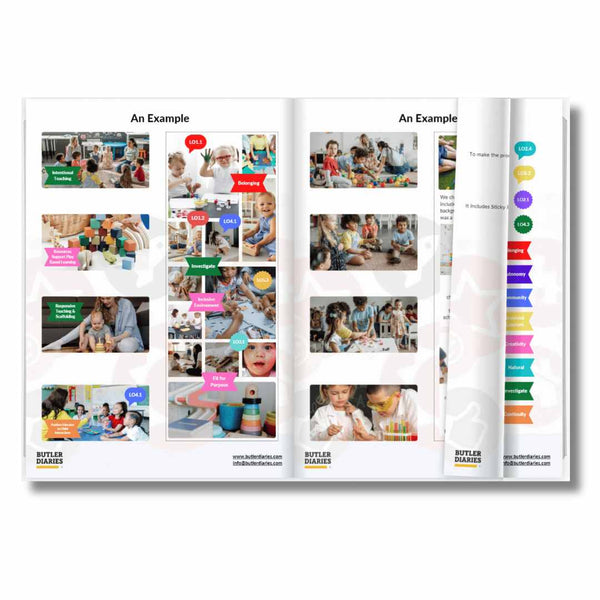
The Butler Method and Butler Diaries Programming and Reflection Diaries are intentionally structured around connecting planning, documentation and reflection rather than treating them as separate jobs.
Prompts and layouts provide educators with a place to capture what is occurring, consider its significance, plan responsively and return to previous thinking.
The goal isn't to increase documentation.
It's to make the cycle easier to see, use and continue.

3. Element 2.2.1 Supervision — 3.1% Not Met
Supervision is now the third most commonly Not Met NQS element.
And unlike some areas of the NQS, the consequences of gaps in supervision can be immediate.
Element 2.2.1 requires reasonable precautions and adequate supervision to ensure children are protected from harm and hazard.
Why supervision can be difficult
Supervision isn't static.
An approach that works at 9:00 am may not work at 11:30 am.
- Children move.
- Educators move.
- Environments change.
- Doors open.
- Transitions occur.
- Educators go on breaks.
- Children's abilities and risk-taking develop.
- A new child joins the group.
- Something unexpected happens.
This means supervision can't simply be a plan that is written once and considered complete.
What stronger everyday practice can look like
Educators understand why they position themselves where they do.
Teams communicate when circumstances change.
Blind spots are known and reviewed.
Transitions are considered carefully.
Supervision responds to the children actually present, their abilities and the environment being used.
Near misses and incidents become opportunities to review practice rather than isolated events to file away.
Questions to ask your team
-
Where are our current supervision blind spots?
-
Which parts of our day make supervision most difficult?
-
What happens to our supervision arrangements when an educator leaves the space?
-
How do we communicate changes in positioning?
-
Have incidents or near misses revealed patterns we need to investigate?
How Butler Diaries helps address this
Supervision is strongest when consideration of risk, positioning, incidents and changing circumstances is part of everyday practice rather than something reviewed only before Assessment and Rating.
Relevant Butler Diaries service diaries provide structured spaces for recording and reviewing the operational information that surrounds supervision — helping leaders and educators keep important considerations visible, organised and able to be revisited.
A tool like the Incident Response Book and the Incident, Injury, Trauma and Illness Record Triplicate Book can help keep a record of supervision lapses and what action was taken to improve processes and response to incidents.

4. Element 1.3.2 Critical Reflection — 3.1% Not Met
Critical reflection has consistently appeared near the top of the Not Met data.
In Q2 2024, 5.2% of services did not meet Element 1.3.2. In Q2 2026 that figure is 3.1%.
That's an encouraging improvement.
But it remains the fourth most commonly Not Met element.
Why critical reflection can be difficult
One problem may be confusion between reflection and critical reflection.
"We did painting today and the children really enjoyed it."
That's a reflection on what happened.
Critical reflection asks more.
- Why did we make the decisions we made?
- What assumptions influenced us?
- What did we notice about children's learning?
- Whose perspectives have we considered?
- What don't we know yet?
- Could another perspective challenge our interpretation?
- What might we change?
- And what happened after we changed it?
What stronger everyday practice can look like
Critical reflection doesn't need to mean writing an essay.
It means thinking deeply enough that reflection can influence practice.
Sometimes that happens individually.
Sometimes it happens through a team conversation.
Sometimes it begins with a question written quickly in a diary that educators return to later.
The important part is what the thinking does.
Questions to ask your team
-
Are we mostly describing what happened or questioning why it happened?
-
Whose perspective might be missing from our reflection?
-
What assumptions are we making?
-
Has anything actually changed because of our reflection?
-
Can we show examples where reflection influenced subsequent practice?
How Butler Diaries helps address this
Critical reflection has long been built into Butler Diaries because finding the time — and knowing where to start — can be one of the biggest barriers.
Rather than leaving educators with a blank box labelled "Reflection", the relevant Programming and Reflection Diaries provide prompts and structured opportunities to capture thinking throughout practice.

Reflection doesn't just stop at the Programming Diaries, Leadership Diaries like the Children's Centre Diary and Nominated Supervisor Diary include reflection prompts and spaces.

The aim is not to manufacture reflection for Assessment and Rating.
It is to make reflection easier to incorporate into the everyday cycle so that thinking can be revisited, extended and acted upon.
5. Element 2.1.2 Health Practices and Procedures — 2.9% Not Met
Health practices and procedures is the fifth most commonly Not Met element.
Element 2.1.2 centres on effective illness and injury management and hygiene practices being promoted and implemented.
The key issue again isn't simply whether a service has a procedure.
It's whether the procedure lives in practice.
Why services can struggle
Health practices involve dozens of small actions occurring throughout busy days.
- Food handling
- Cleaning
- Hand hygiene
- Illness
- Medication
- Injury
- Sleep and rest
- Nappy changing and toileting
- Infection control
- Communication
- Recording
Individually, many of these processes seem routine.
Collectively, they rely heavily on consistency.
What stronger everyday practice can look like
Educators understand the reasons behind procedures rather than simply following a checklist.
Health information is current and accessible.
Responsibilities are clear.
Recurring checks occur.
Changes are communicated.
Patterns in illness, injury or health concerns are noticed and followed up.
Questions to ask your team
-
Which health procedures are most vulnerable when the service becomes busy?
-
Are educators confident about why our procedures exist?
-
Where could inconsistency occur between rooms, educators or shifts?
-
How do we know recurring health and hygiene processes are actually occurring?
-
When something changes, how effectively does that information reach everyone who needs it?
How Butler Diaries helps address this
Butler Diaries service-specific diaries and compliance tools bring recurring health, safety and operational responsibilities into the everyday workflow.
Instead of relying on memory or scattered records, prompts, checklists and dedicated recording areas can help services keep important health practices visible and consistently followed through.
Again, the diary doesn't create compliant practice.
It supports the system around the practice.
Tools like Incident Response Book and the Incident, Injury, Trauma and Illness Record Triplicate Book can assist in creating simple and consistent systems.
6. Element 7.2.2 Educational Leadership — 2.3% Not Met
Educational leadership remains one of the seven most commonly Not Met elements.
And this is an interesting one because almost every service has an Educational Leader.
The challenge isn't necessarily having one.
It's educational leadership actually occurring.
What this element expects
Educational leadership should support the development and implementation of the educational program and assessment and planning cycle.
That means the role needs to influence practice.
Why services can struggle
Educational Leaders often have limited dedicated time.
They may be excellent educators but have received little preparation for mentoring adults.
They can become the person who checks programs rather than the person who builds educator capability.
Professional conversations happen but aren't followed up.
Ideas are discussed but disappear into the busyness of the week.
What stronger everyday practice can look like
An Educational Leader is visible in professional conversations.
- They ask questions.
- They mentor.
- They help educators connect theory with practice.
- They support reflection.
- They identify areas for professional learning.
- They revisit previous discussions.
And over time, you can see their influence in educator capability and the educational program.
Questions to ask your team
-
How does our Educational Leader influence everyday practice?
-
What has changed because of their leadership?
-
Do educators know how and when to seek their support?
-
Does educational leadership primarily involve checking documentation or developing educators?
-
How are professional conversations followed up?
How Butler Diaries helps address this
The Educational Leader Diary was designed around the practical reality that educational leadership needs somewhere to live.
It provides structure for planning leadership priorities, mentoring, professional conversations, reflection and follow-up so important thinking isn't lost between competing responsibilities.
It doesn't replace the skill of the Educational Leader.
It helps give that skill a working system.

7. Element 7.2.3 Development of Professionals — 2.2% Not Met
Professional development isn't simply attending a webinar and filing the certificate.
Element 7.2.3 expects educators, coordinators and staff members' performance to be regularly evaluated and individual plans to be in place to support learning and development.
Why services can struggle
Professional development can become event-based.
- Attend training.
- Receive certificate.
- File certificate.
- Done.
But professional growth requires more than attendance.
- What did the educator learn?
- Why was this learning relevant?
- How could it influence practice?
- What support is needed?
- Did anything change?
- What should come next?
What stronger everyday practice can look like
Professional learning connects to educator goals, service priorities, children's needs and areas identified through reflection.
- Learning is revisited.
- Educators share knowledge.
- Leaders follow up.
Development is ongoing rather than limited to annual performance reviews.
Questions to ask your team
-
How are individual professional development needs identified?
-
Does our professional learning connect with issues we're seeing in practice?
-
What happens after someone attends training?
-
How do educators share professional learning with colleagues?
-
Can we identify ways professional development has changed practice?
How Butler Diaries helps address this
The Professional Development Log Book and Educational Leader Diary help turn professional learning into an ongoing process rather than a collection of certificates.
They provide somewhere to capture professional development, learning, reflection and follow-up — helping services connect professional learning with the development of actual practice.

What About the Remaining Top 10?
Three further elements round out the current top 10:
2.2.2 Incident and emergency management — 1.9%
1.1.3 Program learning opportunities — 1.5%
7.2.1 Continuous improvement — 1.3%
These shouldn't be dismissed simply because their percentages are lower.
In fact, their presence strengthens the pattern.
Incident and emergency management sits alongside supervision and health practices.
Program learning opportunities sits alongside assessment, planning and critical reflection.
Continuous improvement sits alongside management systems, educational leadership and professional development.
The data isn't giving us ten unrelated problems.
It's showing clusters of interconnected practice.
What Has Changed?
Looking at the longer-term figures adds another important layer.
In Q2 2024, the top results included:
-
Assessment and planning cycle — 5.3% Not Met
-
Critical reflection — 5.2%
-
Management systems — 4.2%
-
Educational leadership — 3.8%
-
Health practices and procedures — 3.7%
-
Supervision — 3.7%
-
Development of professionals — 3.2%
By Q2 2026, all seven percentages were lower.
That's positive.
But every one of those seven elements is still in the seven most commonly Not Met elements two years later.
The percentages are improving.
The areas services find hardest have barely changed.

That suggests these aren't simply temporary issues.
They are persistent areas where services may benefit from ongoing support.
Having It Isn't the Same as Embedding It
There's a common thread running through much of this data.
A service can have:
- a supervision plan,
- a reflection template,
- an Educational Leader,
- a professional development folder,
- health procedures,
- management systems,
- and a Quality Improvement Plan.
Yet the NQS asks much more than whether these things exist.
The real question is what happens because of them.
| HAVING IT | EMBEDDING IT |
|---|---|
| A reflection template | Reflection influences practice |
| A planning format | Planning responds to learning |
| A supervision plan | Supervision continually responds to risk |
| Health procedures | Procedures are understood and consistently implemented |
| An Educational Leader | Educational leadership develops educator practice |
| PD certificates | Professional learning influences practice |
| Management checklists | Systems identify issues and trigger action |
| A QIP | Continuous improvement is actually occurring |
This is an important distinction when services think about Assessment and Rating.
The goal shouldn't be to produce more evidence.
The goal is to strengthen the practice that naturally creates evidence.
What Does the Data Mean for Your Service?
Being Meeting or Exceeding NQS doesn't mean these results aren't relevant to you.
The national data provides a useful opportunity for self-assessment.
Take the seven persistent areas and ask your team:
Management systems: Are our systems working or simply existing?
Assessment and planning: Can we clearly follow the cycle?
Supervision: Does our approach continually respond to changing risk?
Critical reflection: Is our reflection changing anything?
Health practices: Are procedures consistently understood and implemented?
Educational leadership: Can we see the Educational Leader's influence on practice?
Professional development: Is learning developing professionals or simply creating certificates?
You don't need to wait for Assessment and Rating to ask those questions.
In fact, that's exactly the point.
We've got an Assessment and Rating Readiness Course that explores being always A&R ready through quality, embedded practice (release date 2027).
Where Butler Diaries Fits
Butler Diaries has always been built around a fairly simple problem:
Early Childhood Education and Care professionals have an enormous amount to think about, remember, plan, review, record and follow up.
Generic diaries weren't designed around that reality.
Neither were blank notebooks.
So our approach has been to build the prompts, structures and recurring responsibilities of particular ECEC roles into tools educators and leaders can actually use throughout their working day.
The latest NQS data reinforces why that matters.
It shows persistent challenges around:
- systems
- planning
- reflection
- supervision
- health practices
- leadership
- professional development
These are areas where relying on memory, disconnected records or once-a-year preparation can make already complex responsibilities harder.
A Butler Diaries product cannot make an NQS element Met.
It cannot replace educator knowledge, professional judgement, effective leadership or quality practice.
What it can do is provide the structure around those things.
- Prompt the reflection.
- Keep the responsibility visible.
- Connect the planning.
- Capture the professional conversation.
- Create somewhere to follow up.
- Bring recurring tasks into the everyday workflow.
- And make it easier to revisit what happened next.
That's why we don't see documentation as the end goal.
The system should support the practice.
And when the practice is happening consistently, the documentation should become a natural record of it.
What the Not Met NQS Data Is Really Telling Us
There is plenty of positive news in the latest NQF Snapshot.
92% of services with a quality rating are Meeting NQS or above.
And the Not Met percentages across the seven highest-ranked elements have all improved compared with Q2 2024.
But the same areas continue appearing near the top.
That gives the sector something useful.
Not a list of failures.
A list of places worth looking more closely.
Because if management systems, planning cycles, supervision, critical reflection, health practices, educational leadership and professional development are proving persistently difficult across the Australian sector, they're worth putting on the agenda at your next team discussion.
Not because Assessment and Rating might be coming.
But because these practices sit at the centre of a well-run, reflective, safe and continually improving Early Childhood Education and Care service.
And that is worth strengthening every day.
Related Articles