
Butler Buzz
Resources, how-tos, and sector insights to help you document better, reflect deeper, and thrive in your practice. Our go-to resource for programming support, compliance guidance, and inspiration.

Tips for using the Weekly Teacher Planning Diary for Primary School Teachers
Tips for using the brand new Weekly Teacher Planning and Reflection Diary

Understanding the New Weekly Programming Reflection Diary Layout
Learn what’s changed in the Weekly Programming and Reflection Diary layout, why the update was made, and how it better aligns with the EYLF. Clear guidance on where to record experiences and how to plan holistically.

Child Development Age Calculator
A tool like the Child Development Age Calculator can offer support by providing a quick way to check typical achievements in areas like physical skills, thinking abilities, and emotional growth. These may be helpful when developing goals for the child.

How to Enhance Documentation With Codes
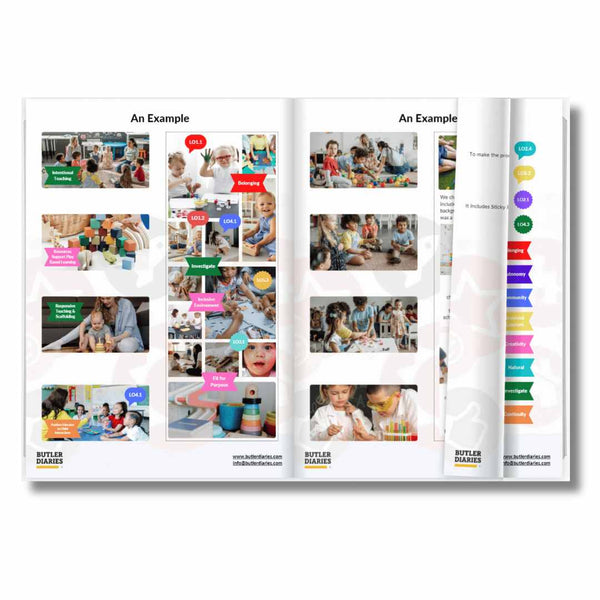
Documentation doesn’t need to be longer to be stronger — it needs to be easier to follow. This practical guide explains how educators can use coding systems (like initials, dates, stickers, colour coding, EYLF learning outcomes and NQS tags) to make the cycle of planning clear, consistent, and easy to evidence. With simple examples for both programming and leadership diaries, you’ll learn how to strengthen compliance and show intentional teaching without increasing workload.

How to Build a Culture of Critical Reflection
Critical reflection isn’t built on motivation — it’s built on structure. In Early Childhood Education and Care, a culture of critical reflection helps educators improve practice, strengthen programming decisions, and create stronger evidence for the NQS. This blog breaks down practical ways to embed reflection into daily routines without adding more workload.

How to Do Weekly Programming and Reflection Using the Cycle of Planning
This post breaks down a simple weekly routine based on the Cycle of Planning, and shows how to document it in a way that’s realistic, consistent, and evidence-friendly. It is a practical step-by-step guide for overwhelmed educators who want clarity, consistency, and evidence without over-documenting.

How to show evidence of updated practice for the 2025-2026 NQS changes
For many services, the pressure point won’t be doing the work — it will be proving the work has changed, and that it is not just a policy update sitting in a folder. This is where your Exceeding Guidance Summary becomes a genuine strategic tool: it helps you capture, organise, and clearly communicate how your practice is being reviewed, improved, embedded, and sustained — especially in relation to new expectations around child safety, governance, and leadership.

What to Include in Each Programming Box
“What actually goes in each programming box?” This post breaks down ideas for what to include in each programming box, links them clearly to the EYLF, and — most importantly — explains why the same experience can legitimately sit in different boxes, depending on your purpose.

NQS 2026 Updates and 2025 Policy Guidelines: Downloadable Resources
Learn about the upcoming NQF child safety changes coming into effect in September 2025 and January 2026, and download your NQS 2026 Update Pack, including NQS Summary, Service Leader Checklist, National Model Code Checklist, and Staff Handout.

Support Directories: Finding the Support You Need on Our Website
Finding support shouldn’t be a challenge. Our website brings everything you need into one place—from help using your diary, to professional development, to live assistance when you need a real person. Here’s a simple guide to where you can find support and what’s available to help you stay organised, confident, and connected in your ECEC practice.

Educator Reflection Prompt Finder
Finding time to pause and think about your practice can be tough. Yet, reflection is where real growth happens. Tools like the Educator Reflection Prompt Finder are here to make that process easier, guiding you with targeted questions to unpack your experiences and plan for better outcomes.

EYLF Outcome Calculator
Type in a brief description of an activity or observation, like 'children building with blocks.' The tool uses a predefined mapping to connect your input to the five EYLF outcomes. You’ll get a breakdown of the most relevant outcomes and a quick note on how the activity supports each one.

Cultural Resource Converter
Educators can access tailored suggestions that highlight unique props, language, or customs, making lessons resonate with every child. It’s about creating spaces where everyone feels seen, and the impact of that can’t be overstated. Start exploring ways to enrich your teaching today!

7 Ways to Boost Early Childhood Learning and Memory
This article explores seven transformative strategies for enhancing early childhood learning and memory, derived from expert insights on brain development. These strategies align seamlessly with the principles of the Early Years Learning Framework (EYLF) and provide actionable methods for educators seeking to elevate their teaching practices.

Closing a Critical Gap in Child Protection for the ECEC Workforce
Recent changes to legislation in New South Wales have strengthened child protection measures in the early childhood education and care (ECEC) sector. The amendments address a long-standing gap between prohibition notices and the Working With Children Check (WWCC).

Halloween STEM Experiences for Early Learning
Halloween offers more than costumes and decorations — it’s a chance to spark curiosity and learning through hands-on, themed STEM activities. Inside are some engaging ideas to bring into your service that will delight children while supporting key EYLF learning outcomes.

Fun and Sustainable Ways to Reuse Your Butler Diaries Packaging
At Butler Diaries, we’re committed to sustainability — that’s why every box we send has already been reused at least three times. But the journey doesn’t need to end there! Both our cardboard boxes and air pillows can be transformed into exciting, EYLF-linked learning experiences. From building box cities and puppet theatres to turning air pillows into sensory play and STEM experiments, here are creative ways to give your packaging a second life in your service.

15 Halloween Experience Ideas for Early Childhood Settings (Linked to EYLF v2.0)
Halloween can be a fun and engaging celebration in Early Childhood Education and Care. Beyond costumes and treats, it offers plenty of opportunities to build creativity, connection, and learning experiences for children in ways that align with the EYLF and MTOP. Here are 15 experience ideas you can use to celebrate Halloween in your service.