
Why Handwritten Reflection Still Matters in a Digital World
Does handwriting still have a place in modern Early Childhood Education and Care? Discover how reflective writing supports deeper thinking, professional judgement, critical reflection, and more intentional programming, helping educators move beyond simply recording information to truly analysing and improving practice.

What research tells us about writing, thinking, and reflective practice in Early Childhood Education and Care
Technology has transformed many aspects of Early Childhood Education and Care.
Observations can be recorded on tablets.
Learning stories can be shared instantly with families.
Programming can be completed online.
Reports can be generated with a few clicks.
Digital tools offer many benefits, and for many services they form an important part of daily practice.
Yet despite these advances, many educators continue to reach for a notebook, diary, reflection page, or sticky note when they need to think through a challenge, plan an experience, or reflect on practice.
Why?
The answer may have less to do with habit and more to do with how writing supports thinking.
Emerging research suggests that handwriting engages the brain differently from typing. Because handwriting is slower and requires greater cognitive involvement, it may support deeper processing, stronger connections between ideas, and more reflective thinking. This is particularly relevant in professions where observation, analysis, and professional judgement are central to practice.
For educators, this raises an important question.
What if the value of handwriting is not the paper itself, but the thinking it encourages?
Reflection Is More Than Recording Information
One of the biggest misconceptions about reflection is that it simply involves documenting what happened.
In reality, reflection is a process of analysing experiences, questioning assumptions, and considering future action.
The EYLF describes reflective practice as a way for educators to continually examine what they do, why they do it, and how their decisions influence outcomes for children.

This requires more than information collection.
It requires thinking.
When educators slow down enough to write, they often begin noticing details, patterns, and possibilities that may otherwise be overlooked.
The reflection becomes an opportunity to explore rather than simply record.
Why Slowing Down Can Improve Thinking
In a busy environment, speed often feels productive.
However, reflective practice is rarely strengthened by rushing.
When educators type quickly, the focus can unintentionally shift towards recording information as efficiently as possible.
Handwriting naturally introduces a slower pace.
This pause creates opportunities to:
-
notice patterns
-
evaluate decisions
-
make connections
-
identify questions
-
challenge assumptions
The goal is not to write more.
The goal is to think more deeply.
The Link Between Writing and Professional Judgement
Every day, educators make decisions about:
-
children's learning
-
environment design
-
intentional teaching opportunities
-
relationships
-
routines
-
programming priorities
These decisions rely on professional judgement.
Professional judgement develops through observation, experience, reflection, and ongoing learning.
Research into reflective writing suggests that writing helps individuals organise experiences, make meaning from events, and develop metacognitive awareness – the ability to think about their own thinking.
This is one reason reflective writing has long been recognised as an important professional learning tool across education, health, leadership, and other professions.
Writing helps make thinking visible.
What This Looks Like in Practice
Imagine an educator records the following note:
"Children spent 40 minutes collecting leaves and arranging them in patterns."
A digital record captures what happened.
A handwritten reflection might explore:
-
Why were children so engaged?
-
What learning was taking place?
-
What theories were children testing?
-
How could this interest be extended?
-
What does this reveal about children's relationship with the natural environment?
The observation remains important.
However, the reflection creates the learning opportunity for the educator.

Handwriting and Critical Reflection
Critical reflection asks educators to move beyond describing events.
It encourages them to examine beliefs, assumptions, perspectives, and practice.
Questions might include:
-
Why did I respond that way?
-
What influenced my decision?
-
Whose perspectives are represented?
-
What alternative approaches could be considered?
These questions require deliberate thinking.
Many educators find that writing responses by hand helps create space for this process.
The slower pace encourages exploration rather than quick conclusions.
Creating Space for Reflection
One challenge many educators face is not understanding reflection.
It is finding time for reflection.
This is where having dedicated spaces for reflective thinking becomes valuable.
Rather than trying to remember insights throughout the day, educators can capture them as they arise.
For example:
-
quick reflection notes after an experience
-
programming reflections
-
professional goals
-
team discussion notes
-
critical reflection prompts
-
observations requiring follow-up
Over time, these small reflections build a picture of professional growth.
Supporting Reflective Practice Through Everyday Documentation
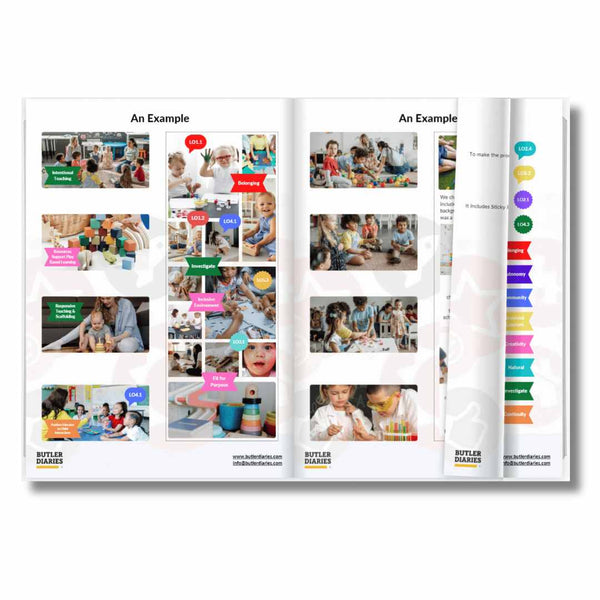
A Weekly Programming and Reflection Diary provides dedicated spaces for documenting observations, analysing learning, recording reflective notes, and evaluating programs over time.
Many educators also use monthly notes pages to:
-
identify emerging interests
-
track learning patterns
-
document reflective conversations
-
record professional questions
-
evaluate changes to practice
The value is not simply the record.
The value is the thinking process the record supports.
Paper Versus Digital Is the Wrong Question
Too often discussions focus on whether paper or digital documentation is better.
In reality, most services use a combination of both.
The more useful question is:
Which tools best support educator thinking?
For some tasks, digital systems provide efficiency and accessibility.
For others, handwriting creates opportunities for deeper reflection and analysis.
The strongest documentation systems are often those that support both.
They recognise that documentation is not just about collecting information.
It is about making sense of information.
If your service requires you to complete online programming, we've created the Weekly Critical Reflection Diary that contains only the weekly reflection spread, providing the opportunity for deeper reflections alongside your online programming.

Supporting Children Through Better Reflection
Ultimately, reflective practice is not about documentation.
It is about improving outcomes for children.
Every observation, reflection, conversation, and planning decision contributes to educators' understanding of children's learning.
When reflection becomes more thoughtful, intentional, and analytical, programming becomes more responsive.
Relationships become stronger.
Learning opportunities become richer.
The purpose of reflection is not to create paperwork.
The purpose of reflection is to strengthen practice.
Important Reminder
The value of handwriting is not found in the pen or the paper.
It is found in the opportunity to slow down, think deeply, and engage with practice more intentionally.
Whether your documentation system is paper, digital, or a combination of both, the most important question remains the same:
Does it support meaningful reflection?
Because meaningful reflection is what ultimately drives meaningful practice.
Related Articles
-
The Most Valuable Part of Documentation Isn't the Document
-
Can Writing Reduce Educator Overwhelm? What the Research Suggests
-
Digital vs. Paper: What's Right for your Service?
-
100 Ways to Use the Monthly Notes Pages in Your Programming and Reflection Diary
-
FAQs on the Weekly Programming and Reflection Child Educator Diary