
Early Childhood Communication Diary: Supporting Consistent Communication Across Your ECEC Service
Consistent communication is essential in Early Childhood Education and Care, but important information can easily get lost between educators, shifts and days. Explore how an Early Childhood Communication Diary can support stronger communication with families, clearer team handovers, effective follow-up and everyday practice aligned with the National Quality Standard (NQS).

Communication happens constantly in an Early Childhood Education and Care service.
A family shares something important at drop-off. An educator notices something that needs to be followed up. A message needs to reach the afternoon team. A maintenance issue is spotted. A family asks a question that another team member needs to answer. Something happens during the day that tomorrow's educators need to know about.
The challenge isn't always getting the information in the first place.
The challenge is making sure important information gets where it needs to go.
An Early Childhood Communication Diary, sometimes called an ECEC Communication Diary, communication book or service communication diary, can provide a consistent place for important information to be recorded, communicated, followed up and referred back to.
Rather than relying entirely on memory, verbal handovers, sticky notes or messages scattered across different platforms, a service communication diary, like the Children's Centre Diary or OSHC Diary, can help create a more consistent communication trail across the service.
And while an ECEC Communication Diary doesn't replace conversations, policies, required records or digital systems, it can become a simple part of the everyday communication systems that support educators, leaders, children and families.
What Is an Early Childhood Communication Diary?
The term Early Childhood Communication Diary can be used to describe different types of communication records.
Some communication diaries are used specifically between an individual child's family and educators. Others are designed as a central communication book for educators and leaders across an entire service.
In this article, we're focusing primarily on the second: the whole-service ECEC Communication Diary.
A service communication diary provides a central place where relevant team members can record information that needs to travel across:
-
different educators
-
rooms or groups
-
morning and afternoon shifts
-
different days
-
educators and service leaders
-
families and the service
-
school and OSHC environments, where relevant.

The information itself may be quite simple. The value comes from having a consistent process for what happens to that information next.
Instead of:
Someone mentioned it → hopefully someone remembers.
A communication system can support:
Information received → Recorded → Shared → Actioned → Followed up.
That small difference can have a significant impact on how consistently a service communicates.
Why Is Consistent Communication Important in Early Childhood Education and Care?
Early Childhood Education and Care services are busy environments, and information rarely stays with one person.
An educator who speaks with a family in the morning may not be there at collection time. A Nominated Supervisor may need to know about something noticed by an educator. An afternoon educator may need information from the morning shift. A family request may require action from someone who wasn't present when the conversation happened.
Without a consistent communication system, services can become heavily reliant on individual educators remembering to pass information on.
This is where communication gaps can appear.
A message may be passed verbally to one person but not another. A note may be placed somewhere and forgotten. Someone may assume another educator has followed something up. A family may need to repeat information they have already provided.
A consistent ECEC communication system, like that designed in the Children's Centre Diary or OSHC Diary, helps reduce that reliance on memory by giving information a clear place to go.

Supporting communication between shifts
Shift changes are an obvious point where information can be lost.
The educator who opens the service isn't necessarily the educator who closes it. In larger services, educators may also move between rooms, breaks, programming time and different responsibilities throughout the day.
A central Early Childhood Communication Diary can support handover by providing another point of reference for information that needs to continue beyond one educator's shift.
This is particularly relevant to the National Quality Standard.
Under Element 6.2.1, ACECQA's assessment guidance identifies educators on different shifts communicating with each other about children's earlier experiences and information shared by families as something assessors may observe.
Supporting follow-up
Communication isn't complete simply because something has been said.
Sometimes information requires an action.
A family may ask for something to be followed up. An educator may identify a resource that needs replacing. A maintenance concern may need to be reported. A message may need to reach another team member.
Recording information in a central location can make it easier to see what still requires attention rather than relying on someone remembering a conversation several hours or days later.
Creating continuity across the service
Consistent communication can also support continuity.
Children experience a service across different relationships, routines, educators and environments. Families should not need to start from the beginning every time they speak with a different member of the team.
When appropriate information is communicated effectively, educators are better positioned to understand what has happened previously and what may need to happen next.
Embedded practice
Consistency is also important when services are working towards practice that is genuinely embedded in service operations.
For practice to be embedded, it needs to be part of the way the service operates every day; not something that only happens when a particular educator is working, when Assessment and Rating is approaching, or when someone remembers to do it.
This is particularly relevant to the Exceeding NQS themes, where one of the three themes considered is that practice is embedded in service operations.

A consistent communication system can help support this by creating an agreed process that educators understand and use as part of everyday practice:
Information received → Recorded appropriately → Communicated → Actioned → Followed up
Early Childhood Communication and the National Quality Standard
Communication is embedded throughout quality Early Childhood Education and Care practice.
There is a particularly strong connection with Quality Area 6 – Collaborative Partnerships with Families and Communities.
ACECQA explains that Quality Area 6 focuses on collaborative relationships with families and community partnerships based on active communication, consultation and collaboration.
An Early Childhood Communication Diary alone doesn't demonstrate quality practice against Quality Area 6.
What it can do is support some of the everyday processes that help communication happen consistently.
Quality Area 6: Communication With Families
Strong relationships with families require more than providing information to families.
Communication needs to move both ways.
Families bring valuable knowledge about their child, including their routines, experiences, interests, preferences, culture, values and wellbeing.
Element 6.1.2 of the NQS recognises the expertise, culture, values and beliefs of families and their role in shared decision-making about their child's learning and wellbeing. ACECQA's guidance also identifies information being exchanged between educators and families at arrival and departure as something assessors may observe.
A service therefore needs processes that don't just allow educators to receive information, but help relevant information continue to the people who need it.
For example:
A family shares information → an educator receives it → relevant information is recorded appropriately → the appropriate team member receives it → it informs practice or action where required → the family can be followed up with.
The Children's Centre Diary and OSHC Diary isn't the relationship.
It supports the communication process behind the relationship.

Communication Books and Element 6.1.3
There is also a direct connection between communication methods and Element 6.1.3 – Families are supported.
This element focuses on current information being available to families about the service and relevant community services and resources.
Interestingly, ACECQA's assessment guidance specifically identifies newsletters, communication books and other methods of communication with families as examples assessors may sight.
This doesn't mean every service needs a communication book or that simply having one demonstrates Meeting practice.
It does reinforce something important:
Services need intentional methods for keeping families informed.
The method may be verbal, written, digital or a combination of approaches.
The important question is whether the service's communication systems actually work in practice.
What Can Be Recorded in an ECEC Communication Diary?
What belongs in a communication diary will depend on the service, its policies, confidentiality requirements and the purpose of the diary.
A whole-service ECEC Communication Diary, like the Children's Centre Diary or OSHC Diary, provide space for information relating to areas such as:
Family communication
This may include relevant messages from families, requests requiring follow-up, reminders, general feedback or information that needs to reach another appropriate educator or leader.
Not every family conversation belongs in a general communication diary. Services still need to consider privacy, confidentiality and their requirements for formally documenting particular information.
The communication diary should support existing systems rather than replace them.
Daily service communication
There are also plenty of everyday operational details that need to move through a service.
This might include reminders, visitors, upcoming events, resources required, tasks needing attention or other information relevant to the team.
Having one predictable location for these messages can reduce the number of disconnected pieces of information educators need to keep track of.

Information requiring follow-up
One of the most useful roles of a service communication diary is providing visibility around information that hasn't finished its journey.
Rather than simply recording what happened, educators and leaders can identify what needs to happen next.
For example:
Message received → Who needs to know? → Is action required? → Has it been followed up?
This turns the diary from a notebook into a working communication system.
Team reflection and quality improvement
As well as tracking operational communication, an Early Childhood Communication Diary can be used to critically reflect on practice that impacts the service as a whole.
These reflections can include QIP reflections, policy updates, general practice improvement, or areas of focus raised by educators or leadership.
Reflecting as a whole service, can help the team stay connected to the QIP and service-wide goals.
A Communication Diary Can Create a Communication Trail
This is perhaps the biggest difference between a purposeful Early Childhood Communication Diary and a collection of random notes.
Important information has somewhere to go.
Consider a family who tells the opening educator something that the child's afternoon educator needs to know.
Without an established system, the service may rely on a chain of verbal communication:
Family → Opening educator → Another educator → Afternoon educator
Every additional step creates another opportunity for information to be forgotten, misunderstood or not passed on.
A central communication system creates another reference point.
Receive → Record → Communicate → Action → Follow up
It doesn't eliminate the need for educators to talk to one another.
It's a place where communication lives and educators know to check daily.
It helps conversations continue.
Communication Diaries and Assessment and Rating
An ECEC Communication Diary, like the Children's Centre Diary or OSHC Diary, shouldn't be created or used simply to produce evidence for Assessment and Rating.
The strongest evidence is practice that genuinely occurs every day.
However, a well-used communication system can help make established practice more consistent and visible.
For example, a service may be able to discuss how information from families reaches relevant educators, how morning and afternoon teams communicate, how requests are followed up, or how important information is shared when educators work different shifts.
These are practical systems, not simply documents sitting on a shelf.
ACECQA's guidance for Quality Area 6 repeatedly focuses on what happens in practice: respectful communication with families, information sharing, collaborative decision-making and continuity through transitions.
So rather than asking:
"Do we have evidence of communication?"
a more useful reflective question may be:
"If important information enters our service today, how confident are we that it will reach the right person and be followed up?"
The documentation should support the answer to that question.
Do You Need an ECEC Communication Diary If You Already Use an App?
Digital platforms have become an important part of communication in many Early Childhood Education and Care services.
But a digital platform and a physical service communication diary don't necessarily need to perform the same job.
A service may use an app for family updates, children's documentation, attendance or other records while using a physical diary as a central day-to-day communication point for the team.
The goal shouldn't be to create duplicate documentation.
Instead, consider:
What information do we need to communicate?
Who needs access to it?
Where should it be formally recorded?
Who needs to act on it?
How will we know it has been followed up?
What times of the day is better served by each method?
Sometimes the appropriate answer will be the service's digital system. Sometimes it will be a required record. Sometimes it will be a conversation.
And sometimes a quick entry in a central communication diary is the simplest way to make sure something doesn't disappear between one shift and the next.
Choosing a Communication Diary for an Early Childhood Service
A useful Early Childhood Communication Diary should reflect how the service actually operates.
Rather than providing pages of blank paper, a purpose-designed diary can combine communication with the other information a service needs to organise throughout the day and year.
It sits at the service level and supports communication, organisation and continuity across the team.
Children's Centre Diary: A Communication Diary for Early Childhood Services
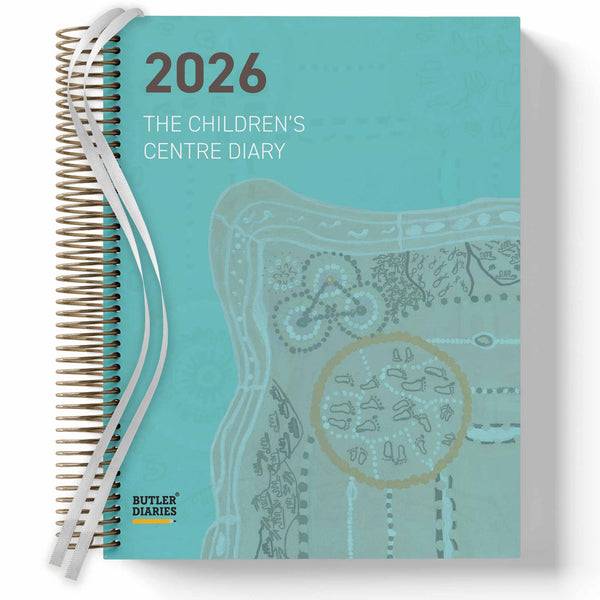
The Butler Diaries Children's Centre Diary is designed as a central diary for Early Childhood Education and Care services.
Rather than using separate notebooks, scraps of paper and disconnected reminders, the Children's Centre Diary brings everyday service information into one organised location.
It can support services to maintain a consistent point of reference for daily communication and organisation across the team.
For services looking for an ECEC Communication Diary, it provides more than somewhere to jot down messages. It is designed around the actual day-to-day operation of an Early Childhood Education and Care service.
This makes it particularly useful where multiple educators, leaders, shifts and responsibilities need to stay connected throughout the day.

OSHC Communication Diaries Have Different Needs
Communication can become even more complex in Outside School Hours Care.
An OSHC service may need information to move between:
families → school → OSHC
before-school team → after-school team
educators → coordinators
school-day care → vacation care
Children and young people are also regularly transitioning between different environments.
Element 6.2.1 of the NQS states that continuity of learning and transitions are supported by sharing information and clarifying responsibilities. ACECQA specifically identifies transitions between school and school-age care and considers how information is shared between educators working in before-school and after-school components of a service.
For school-age services, ACECQA's guidance also considers how information from families about attendance or non-attendance is communicated to educators responsible for children's transitions between school and the service.
That makes a consistent OSHC communication system particularly valuable.
OSHC Diary: A Service Communication Diary for School-Age Care
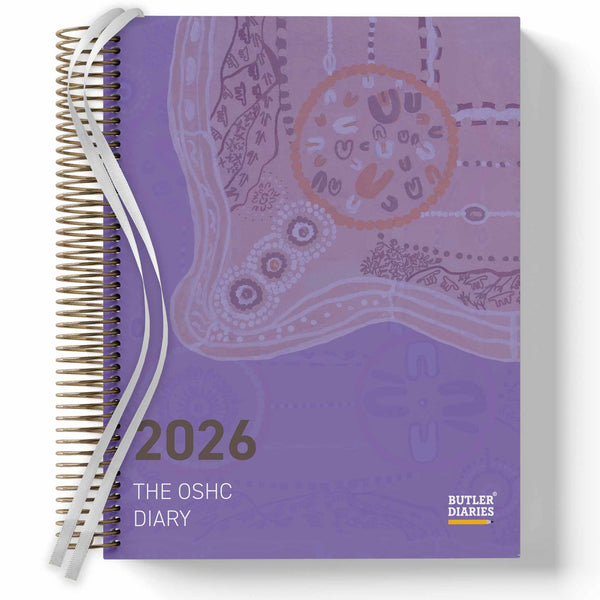
The Butler Diaries OSHC Diary is designed around the particular organisation and communication needs of Outside School Hours Care services.
It provides a central service diary that can help information move between educators and different parts of the day while keeping important service information together.
Rather than adapting a generic diary to an OSHC environment, a purpose-designed OSHC Communication Diary recognises that school-age care has its own routines, transitions, responsibilities and communication needs.
It can become a central reference point that supports the team's broader systems for staying organised and informed.

Making an ECEC Communication Diary Work in Practice
The best communication diary isn't necessarily the one with the most information written in it.
It's the one the team consistently uses.
For a communication diary to be useful, educators need a shared understanding of:
-
where the diary is kept
-
who uses it
-
what should be recorded
-
what should not be recorded
-
how confidentiality is maintained
-
when educators are expected to check it
-
how urgent information is communicated
-
how actions are followed up
-
which information must instead be recorded through formal service records or other systems.
It should also remain a communication support, rather than becoming another documentation burden.
If educators are copying the same information into three different places simply because "that's what we do", it may be worth critically reflecting on the purpose of each system.
Good communication systems should make important information easier to manage, not create more unnecessary paperwork.
You can learn more about embedding these Diaries into your communication practices here.
Reflect on Communication Across Your Service
Consider the last week at your service.
How many pieces of information needed to move from one person to another?
How many relied on someone remembering a conversation?
How does information shared with the morning team reach educators working later in the day?
How do educators know whether a family request has been followed up?
What happens when the person who receives important information isn't the person responsible for acting on it?
How does information move between different shifts, rooms or groups?
For OSHC services, how does information move between before-school care, school, after-school care and families?
And perhaps most importantly:
If an educator wasn't present when something happened, where would they look to find out about it?
A consistent Early Childhood Communication Diary, like the Children's Centre Diary or OSHC Diary, won't replace strong professional communication.
It can help make strong communication easier to maintain.
Because in a busy Early Childhood Education and Care service, the goal isn't to write down everything.
It's to make sure the information that matters doesn't get lost.
Frequently Asked Questions About Early Childhood Communication Diaries
What is an ECEC Communication Diary?
An ECEC Communication Diary, like the Children's Centre Diary or OSHC Diary, is a written communication tool used within an Early Childhood Education and Care setting. Depending on its purpose, it may support communication between families and educators or operate as a whole-service diary that helps relevant information move between educators, leaders, shifts and days.
What is an Early Childhood Communication Diary used for?
A whole-service Early Childhood Communication Diary, like the Children's Centre Diary or OSHC Diary, can be used to record relevant daily messages, family communication, reminders, follow-up items and other information that needs to be communicated across a service. It should complement, rather than replace, required records, policies, professional conversations and other service systems.
What is the difference between a communication diary and a communication book?
The terms communication diary and communication book are often used interchangeably. In Early Childhood Education and Care, either may refer to communication between a family and educators or a central communication system used across a service. Services should consider the intended purpose of the resource rather than relying on its name alone.
Which NQS Quality Area relates to communication with families?
Quality Area 6 – Collaborative Partnerships with Families and Communities has the strongest direct connection to communication with families. It focuses on supportive relationships with families and collaborative partnerships that enhance children's inclusion, learning and wellbeing.
Does the NQS require an Early Childhood Communication Diary?
The National Quality Standard does not require services to use an Early Childhood Communication Diary, like the Children's Centre Diary or OSHC Diary. Services use a range of communication methods. ACECQA's guidance for Element 6.1.3 does, however, identify newsletters, communication books and other communication methods as examples assessors may sight when considering how families are kept informed.
Can a communication diary support Assessment and Rating?
A communication diary, like the Children's Centre Diary or OSHC Diary, can support consistent everyday practice and may help a service demonstrate how its communication systems operate. However, simply having a diary isn't evidence of quality practice. What matters is how communication occurs in practice, how information is used and whether the service's systems contribute to positive outcomes for children and families.
Can we use a paper communication diary if our service already uses an app?
Yes. They don't necessarily need to perform the same function. A service may use digital systems for family communication, attendance or children's documentation while using a physical service diary, like the Children's Centre Diary or OSHC Diary, for internal daily communication and organisation. Services should avoid unnecessary duplication and clearly define the purpose of each system.
Why is communication particularly important in OSHC?
OSHC services manage frequent transitions between home, school and the service, as well as between before-school and after-school educators. Element 6.2.1 specifically connects continuity and transitions with sharing information and clarifying responsibilities, making effective communication systems particularly important in school-age care.